
What Is the Difference Between Herringbone and Parquet Flooring?
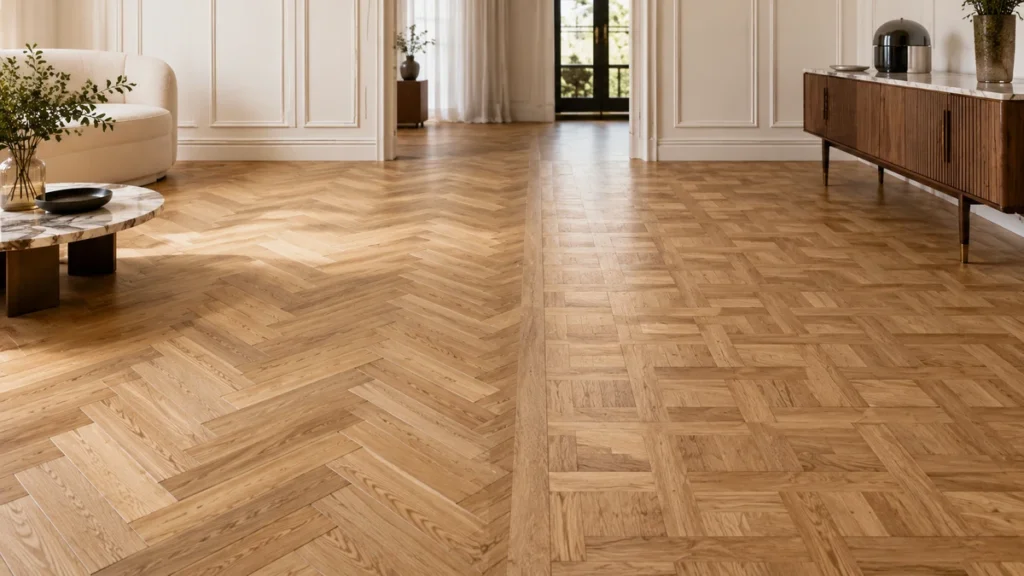
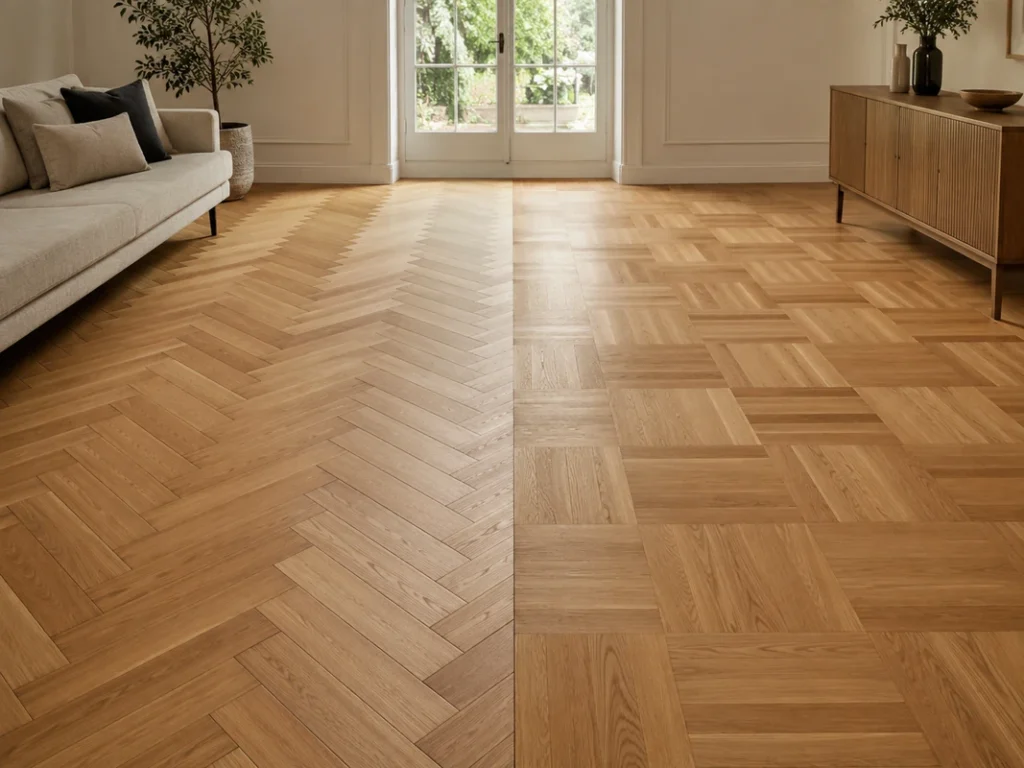
The main difference between herringbone and parquet flooring is that parquet is a broad category, while herringbone is one specific pattern within that category. Parquet describes flooring made from wood blocks or planks arranged in decorative geometric designs. Herringbone uses rectangular pieces laid at right angles to create a staggered zigzag effect. This means every genuine herringbone floor can be described as parquet, but not every parquet floor uses a herringbone layout. Understanding this distinction helps homeowners compare designs more accurately. This guide explains the terminology, layout, installation, materials, cost differences and practical considerations involved when choosing between herringbone and other parquet patterns
Herringbone vs Parquet: The Difference at a Glance
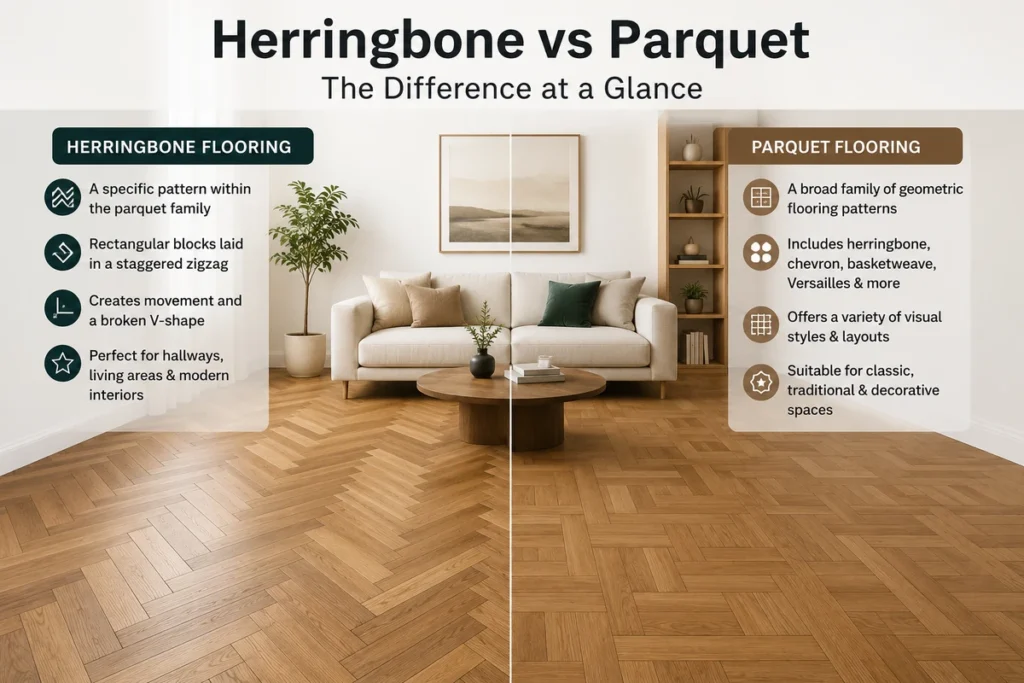
When comparing herringbone vs parquet, the most important point is that they are not two completely separate flooring categories. Parquet is the wider family of decorative geometric floors, while herringbone is one of its best-known members.
The confusion often comes from the way retailers and homeowners use the word “parquet.” Some use it to describe any floor made from small wood blocks, while others use it to refer to traditional square or basket-style designs. In reality, parquet can include herringbone, chevron, basketweave, Versailles panels and several other layouts.
The table below gives a clear overview of the difference between herringbone and parquet
| Criterion | Parquet Flooring | Herringbone Flooring |
|---|---|---|
| What it is | A broad family of geometric flooring patterns | A specific pattern within the parquet family |
| Layout | Includes herringbone, chevron, basketweave, Versailles and other designs | Rectangular blocks arranged in a staggered zigzag |
| Block shape | Depends on the chosen pattern | Usually rectangular pieces with square-cut ends |
| Visual effect | Can be simple, decorative or highly intricate | Creates movement and a broken V-shaped effect |
| Installation | Difficulty depends on the pattern | Requires accurate alignment and a clear centre line |
| Cost | Depends on pattern, material and installation complexity | Usually costs more to fit than straight planks, but not necessarily more than every parquet pattern |
| Material options | Solid wood, engineered wood and parquet-effect products | Available in wood, engineered wood, laminate and LVT designs |
| Best suited to | Depends on the selected pattern | Hallways, living areas and spaces needing visual direction |
In simple terms, parquet vs herringbone is not the same type of comparison as wood versus tile. A more accurate comparison would be herringbone versus other parquet patterns.
What Do Parquet and Herringbone Actually Mean?
Understanding the terminology makes it easier to compare products, quotations and installation options. It also prevents homeowners from assuming that every decorative floor has the same appearance, material or fitting requirements.
What Is Parquet Flooring?
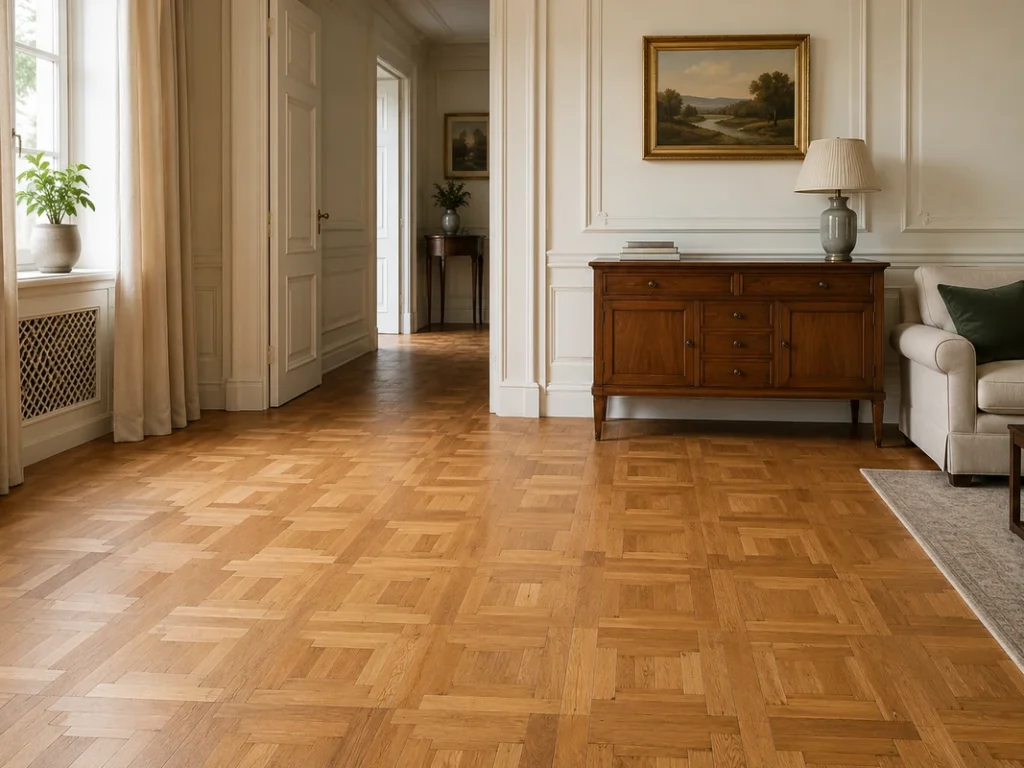
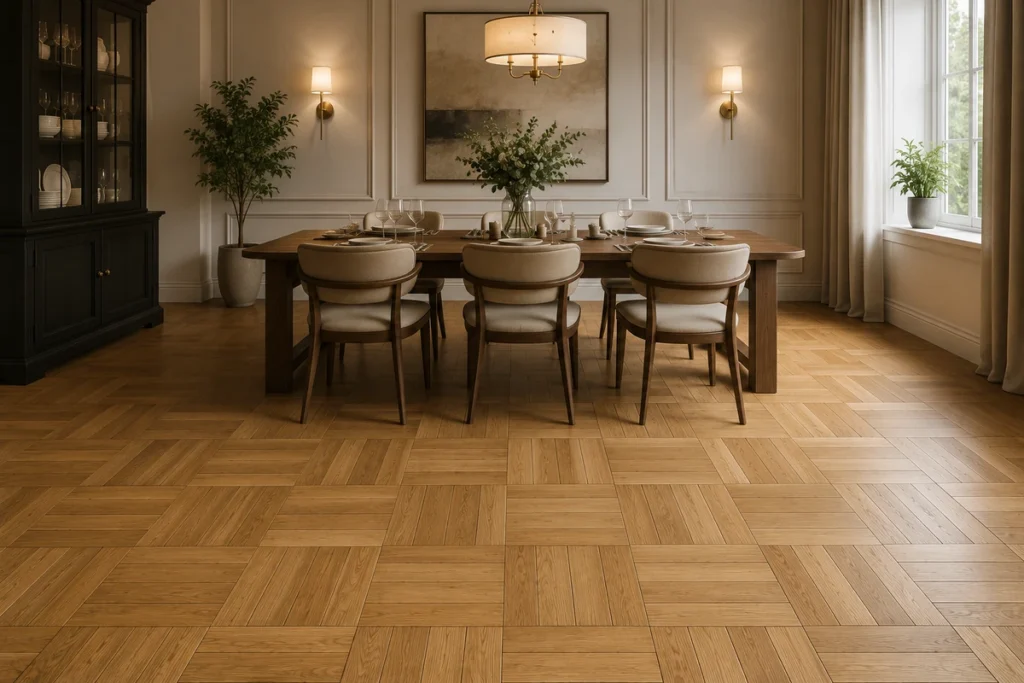
Parquet flooring is made by arranging smaller blocks, boards or pieces into a repeated geometric pattern. Traditional parquet was usually produced from solid timber, but modern products are also available in engineered wood, laminate and vinyl-based formats.
The word “parquet” refers mainly to the arrangement of the pieces rather than one particular species of timber. Oak is common, but walnut, maple and other materials may also be used.
Parquet patterns can range from simple layouts to highly detailed decorative panels. Herringbone and chevron create strong directional lines, while basketweave and Versailles designs appear more balanced and ornamental.
The final look depends on several factors:
- The selected pattern
- The dimensions of each block
- The colour and grain of the material
- The direction of installation
- The size and shape of the room
- The border or perimeter design
Because parquet is a broad category, two parquet floors may look completely different. One may use a subtle oak basketweave, while another may feature dark herringbone blocks with a contrasting border
What Is Herringbone Flooring?
Herringbone flooring uses rectangular pieces with square-cut ends. Each piece meets the side of another piece at a 90-degree angle, creating a broken zigzag pattern.
The name comes from its resemblance to the bone structure of a herring fish. The pattern has been used in architecture and flooring for centuries, but it also works well in modern interiors because it adds movement without appearing overly decorative.
A herringbone parquet layout is highly directional. The rows guide the eye through the room, which can help emphasise the length of a hallway, create a focal point in a living area or visually connect adjoining spaces.
Homeowners can choose herringbone parquet flooring in solid or engineered timber, as well as laminate and LVT products designed to recreate the same pattern. However, the material affects the floor’s durability, feel, maintenance requirements and suitability for different rooms
How Does Herringbone Compare with Other Parquet Patterns?
Herringbone is popular because it combines a classic appearance with enough simplicity to work in both traditional and contemporary homes. However, it is only one of several parquet designs.
The main difference between parquet and herringbone becomes clearer when herringbone is compared with other layouts in the parquet famil
| Pattern | How the Pieces Meet | Overall Appearance | Best For |
|---|---|---|---|
| Herringbone | Square-ended pieces meet at 90 degrees | Broken zigzag with visible movement | Classic and contemporary interiors |
| Chevron | Angled ends meet point to point | Continuous and symmetrical V shapes | Clean, formal and modern spaces |
| Basketweave | Blocks form interlocking squares | Balanced and less directional | Traditional rooms and feature areas |
| Versailles | Multiple pieces form decorative panels | Detailed and highly ornamental | Large or formal interiors |
Herringbone and chevron are frequently confused. Herringbone blocks have straight, square-cut ends, and the end of one piece meets the side of another. Chevron pieces are cut at an angle and meet directly at their points, producing a continuous V shape.
Basketweave has less directional movement. Its interlocking square arrangement can create a calmer and more traditional appearance. Versailles parquet is more complex and is usually supplied as large decorative panels. It suits spacious interiors where the full pattern can be appreciated.
Compared with a herringbone vs straight floor layout, herringbone appears more decorative and visually active. Straight planks usually make the room feel cleaner and simpler, while herringbone adds texture, craftsmanship and a stronger design feature.
Installation also differs. Straight planks are normally faster and easier to align. Herringbone requires an accurate centre line, consistent angles and careful planning around walls, doors and borders. More cutting and material waste may also be involved
Which Parquet Pattern Is Right for Your Home?
The right pattern depends on the room, the desired style, the available budget and the level of maintenance you are comfortable with. Choosing the most fashionable pattern without considering the property is a weak approach. The floor should work with the room rather than compete with it.
Herringbone is a strong choice for hallways because its directional layout can lead the eye through a narrow space. In living rooms, it creates an attractive focal point and can make a simple interior feel more refined. It also works well in open-plan homes where the flooring helps define or connect different areas.
Chevron may suit homeowners who prefer cleaner symmetry. Its continuous V shapes create a more formal and precise appearance than the broken zigzag of herringbone.
Basketweave can work well in traditional rooms, dining areas and smaller feature zones. Versailles panels are most effective in larger rooms because their detail can feel crowded in compact spaces
Room size matters, but there is no rule that herringbone should only be used in large interiors. Smaller blocks and lighter finishes can work in compact rooms. Larger blocks and darker colours usually create a stronger, heavier effect.
The direction of the pattern is equally important. Running herringbone toward the main window, along the longest wall or in the direction of movement can affect how the room feels. A professional installer should assess the space before work begins.
Material should also influence the decision. Engineered wood flooring is often more dimensionally stable than solid timber and may be suitable for underfloor heating when approved by the manufacturer. Solid wood floors offer natural character but can react more noticeably to humidity and temperature changes.
Laminate and LVT herringbone products can provide a similar appearance at a lower cost, although they do not have the same structure or refinishing potential as real timber. This makes them practical for homeowners comparing different types of flooring in Dubai, especially where moisture resistance, budget and air-conditioning conditions matter
| Room or Priority | Suitable Pattern | Key Consideration |
|---|---|---|
| Hallway | Herringbone | Directs the eye through the space |
| Modern living room | Herringbone or chevron | Adds movement and a strong focal point |
| Traditional dining room | Basketweave | Creates a balanced, classic appearance |
| Large formal room | Versailles | Needs enough space to show the full design |
| Small room | Light herringbone or simple parquet | Avoid oversized blocks and heavy colours |
| Limited installation budget | Straight planks or parquet-effect products | Usually easier and faster to fit |
Cost should be judged by the entire flooring system, not only the pattern. The price can include the product, subfloor preparation, adhesive, underlay, borders, wastage, installation and finishing. Herringbone normally costs more to install than straight planks because the fitting is slower and more precise. However, it may cost less than complex Versailles panels or customised parquet designs.
Homeowners comparing wooden flooring Dubai suppliers should therefore ask for a detailed quotation rather than assuming that every parquet floor has the same price
conclusion
The difference between herringbone and parquet is mainly a difference between a specific pattern and a broader flooring category. Parquet includes many geometric arrangements, while herringbone uses rectangular blocks positioned at right angles to form a broken zigzag.
Herringbone is a versatile option for homeowners who want movement, character and a design that works in both classic and modern interiors. Other parquet styles may be more suitable when the goal is greater symmetry, less direction or a highly decorative finish.
Before choosing, consider the room dimensions, block size, material, installation cost and overall interior style. The strongest decision is not based only on appearance. It balances design with durability, maintenance and the practical conditions of the home
FAQ
Is herringbone a type of parquet flooring?
Yes. Herringbone is one of the most widely recognised parquet patterns. It uses rectangular blocks arranged at 90-degree angles to form a staggered zigzag
Is all parquet flooring herringbone?
No. All genuine herringbone floors can be considered parquet, but parquet also includes chevron, basketweave, Versailles and other geometric designs.
What is the difference between herringbone and chevron?
Herringbone uses square-ended pieces that meet the sides of adjoining pieces. Chevron uses angled ends that meet point to point, creating continuous V-shaped lines
Is herringbone more expensive than parquet flooring?
Herringbone cannot be priced separately from parquet as a whole because it is a parquet pattern. It is usually more expensive to install than straight planks, but some complex parquet layouts can cost more than herringbone
Does herringbone make a room look bigger?
It can make a room feel longer or more dynamic when the pattern is laid in the right direction. However, block size, colour, lighting and room proportions also affect the final result
Can laminate or LVT flooring have a herringbone pattern?
Yes. Laminate and LVT products are available in herringbone designs. They reproduce the layout of traditional wood flooring but have different construction, performance and maintenance characteristics