
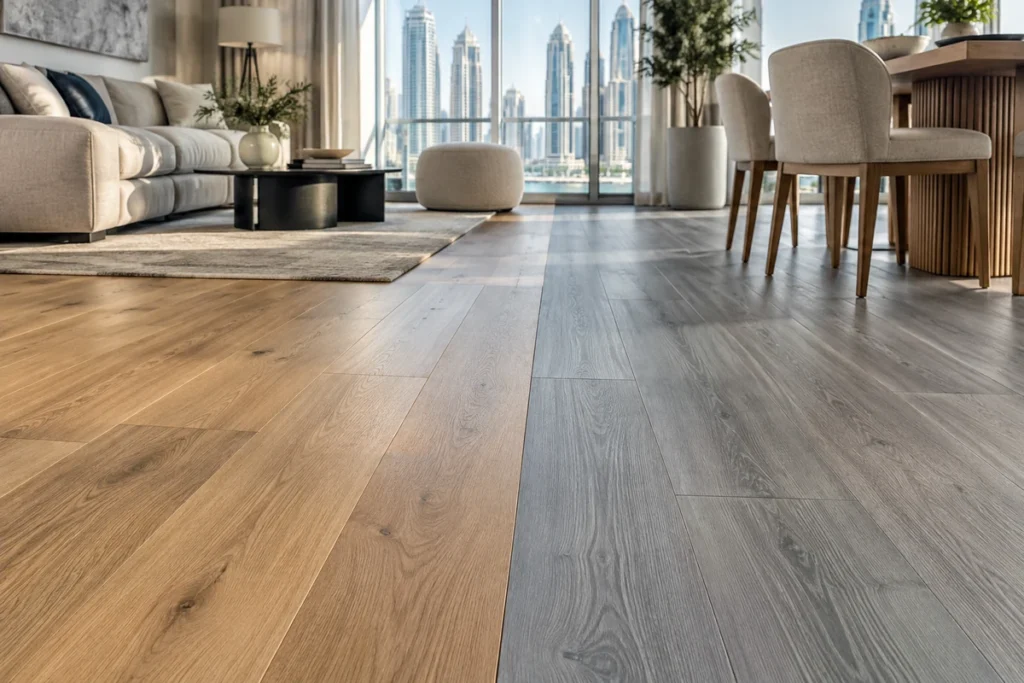
Vinyl vs Wood Flooring in Dubai: Which Is Better for UAE Homes?
For many Dubai homes, luxury vinyl flooring is a practical option when easy maintenance, everyday spill resistance, and a lower upfront budget matter most. Real wood, however, offers natural grain, authentic texture, and greater potential for restoration over time. Engineered wood is especially worth considering for air-conditioned UAE interiors where homeowners want genuine timber with improved dimensional stability. There is no universal winner in the vinyl vs wood flooring decision: the right choice depends on the room, indoor climate, subfloor, installation method, product specifications, and your long-term priorities.
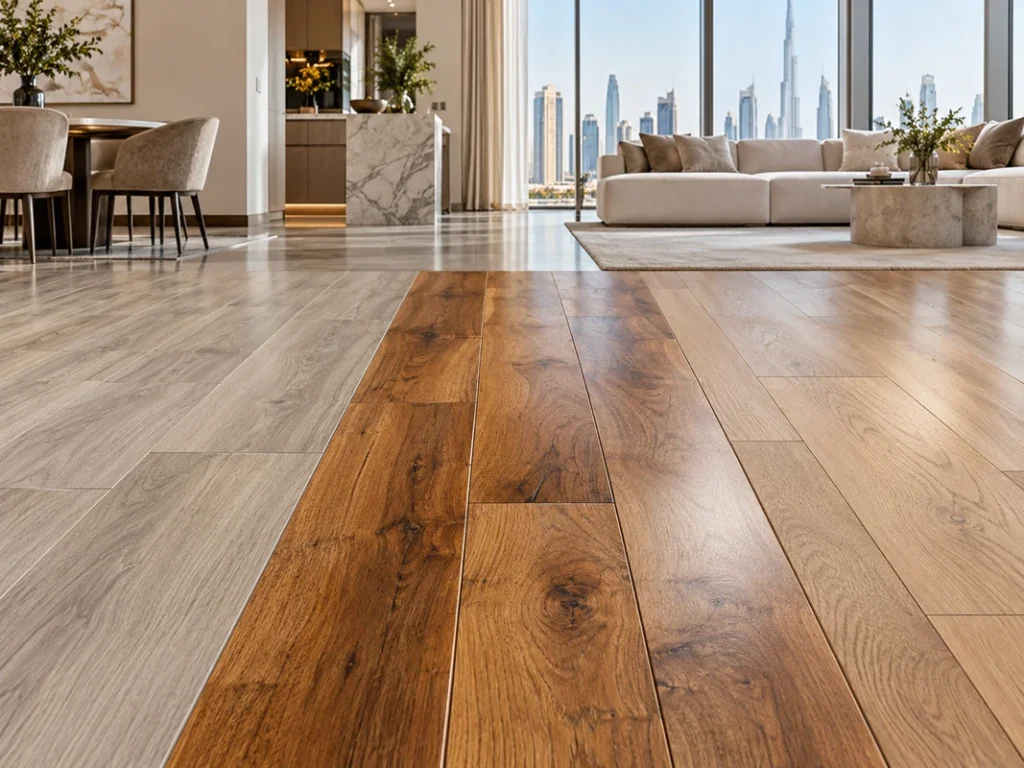
Vinyl vs Wood Flooring: Quick Comparison
The first step in a useful vinyl wood flooring comparison is separating three different constructions.
Luxury vinyl uses synthetic layers with a printed decorative surface that can reproduce the look of timber. LVP usually describes plank-shaped vinyl, while LVT commonly refers to tile formats. Rigid-core products such as SPC flooring are part of the broader vinyl category rather than a completely separate flooring material.
Solid hardwood is milled from a single piece of natural timber. Engineered wood has a genuine wood surface bonded to a multi-layer core designed to improve dimensional stability. For a more detailed explanation of solid, engineered, parquet, and other types of wood flooring, refer to our dedicated wood-flooring guide
| Factor | Luxury Vinyl / SPC | Solid Hardwood | Engineered Wood |
|---|---|---|---|
| Material and appearance | Synthetic construction with printed wood design | Solid natural timber throughout | Real timber surface over engineered layers |
| Water and moisture resistance | Usually more tolerant of spills; system suitability depends on joints and installation | Sensitive to prolonged moisture and humidity changes | More dimensionally stable than solid wood, but still genuine wood |
| Heat and sunlight considerations | Product temperature limits and direct-sun exposure must be checked | Indoor humidity and temperature need control | Designed for stable interiors but still requires controlled conditions |
| Scratch and dent resistance | Depends heavily on wear layer and surface coating | Depends on species, hardness and finish | Depends on timber species and finish |
| Maintenance | Generally simple routine cleaning | Requires wood-appropriate care | Requires wood-appropriate care |
| Installation requirements | Click, floating or glue-down depending on product | Nail, glue or other specified systems | Floating or glue-down systems are common |
| Repair and refinishing | Individual planks may sometimes be replaceable; sanding is generally not an option | Can often be sanded and refinished multiple times | May be refinished depending on wear-layer thickness and construction |
| Upfront and long-term cost | Usually lower initial cost | Usually highest initial investment | Usually between vinyl and premium solid hardwood |
| Best-suited applications | Busy homes, rentals and areas needing easy maintenance | Controlled interiors where natural solid timber is the priority | Premium living spaces and long-term residential interiors |
Vinyl vs Wood Flooring: Key Differences for UAE Homes
Heat, Humidity, and Water Resistance
Dubai’s outdoor climate is hot and often humid, but flooring is normally installed inside an air-conditioned building. What matters to the floor is therefore not simply the weather forecast outside; it is the temperature, relative humidity, direct solar exposure, moisture in the subfloor, and how consistently the interior is conditioned.
Wood is hygroscopic, meaning it exchanges moisture with the surrounding air. Changes in relative humidity can therefore cause wood flooring to expand or contract. Kährs, for example, specifies a relative-humidity range of 30–60% for its wood floors before, during and after installation. Barlinek specifies 45–60% RH and 18–24°C for relevant engineered products. These manufacturer-specific ranges illustrate why the specification of the actual product matters more than a blanket statement that wood is or is not suitable for Dubai.
Engineered construction generally offers better dimensional stability than a comparable solid timber board because its layered core limits some natural wood movement. That does not make engineered wood waterproof. Spills still need attention, and uncontrolled humidity, plumbing leaks or moisture moving through a concrete slab can create problems.
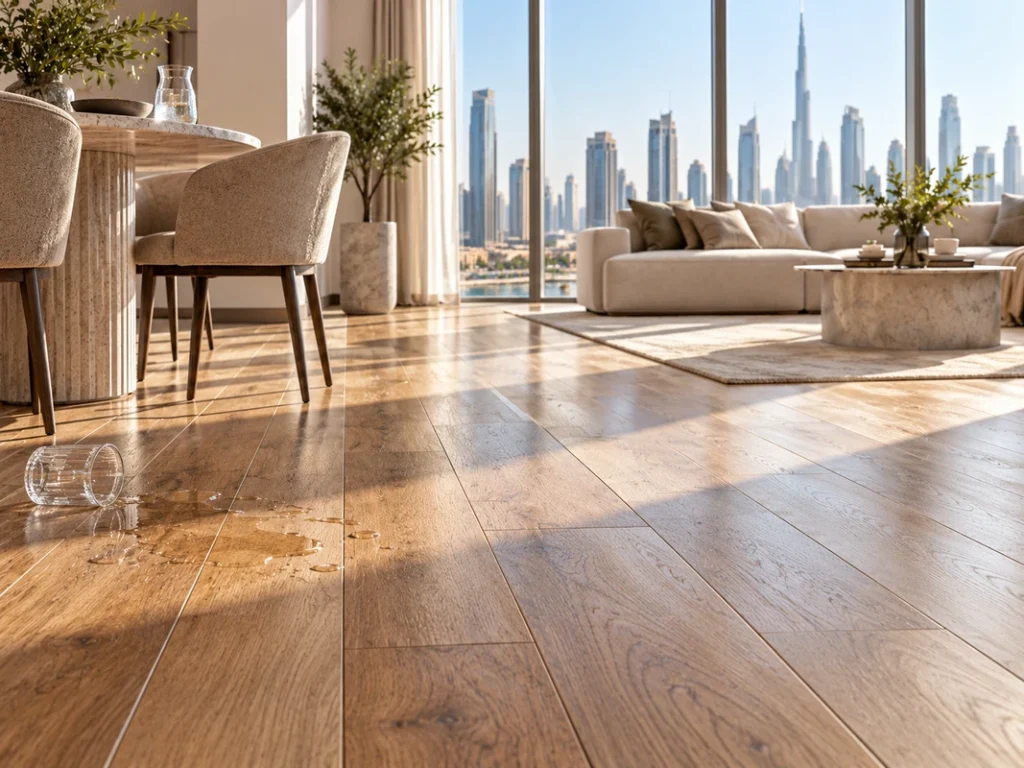
Luxury vinyl and rigid-core SPC are typically less vulnerable to everyday spills than real wood, but a waterproof plank is not automatically a waterproof flooring system. Water may still reach the subfloor through room edges, penetrations, damaged joints or installation details.
Dubai sunlight also deserves attention. Imagine a Dubai Marina apartment with floor-to-ceiling glazing or a villa living room receiving strong afternoon sun. The flooring directly behind the glass can experience much higher surface temperatures than the air-conditioned room. Karndean advises protecting vinyl from strong direct sunlight and specifies installation temperatures for its products rather than describing them as universally heatproof.
Which flooring handles Dubai’s heat and humidity better? Vinyl or SPC can be more forgiving where everyday moisture is the main concern, while engineered wood can perform well in consistently conditioned interiors. In both cases, the manufacturer’s temperature limits, solar-exposure guidance and subfloor requirements should decide whether a specific product is suitable
Durability, Appearance, and Maintenance
Is luxury vinyl more durable than real wood? It depends on what type of durability matters.
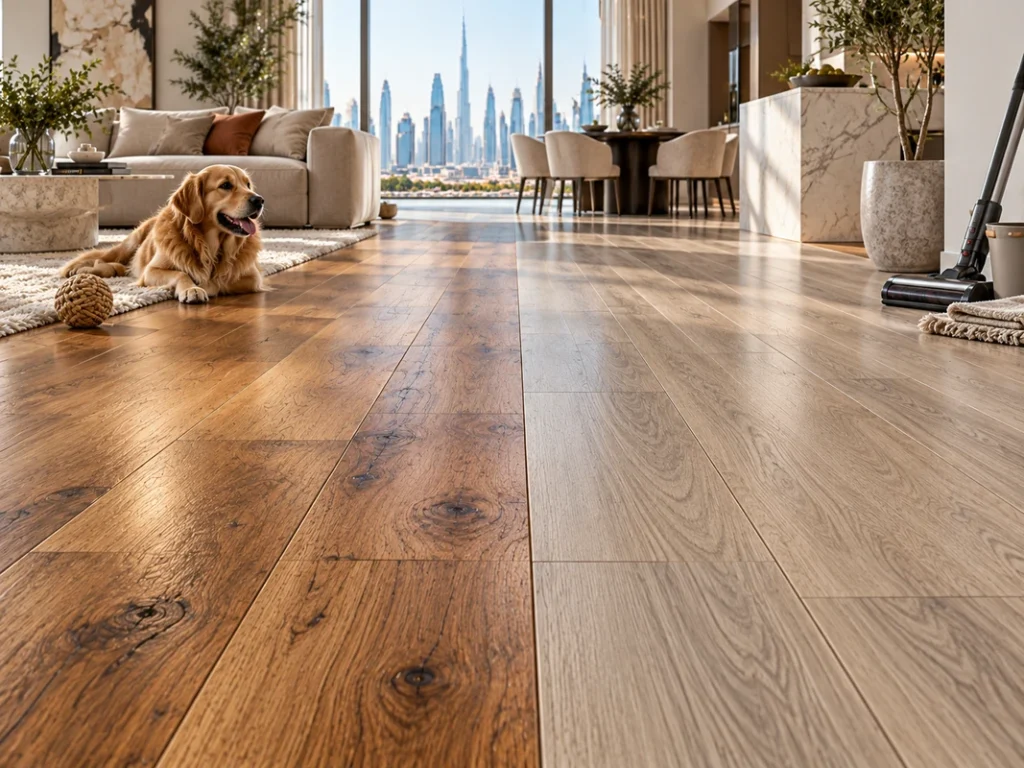
A good vinyl floor can resist everyday scuffs, spills and household wear effectively. Its performance depends on factors including the wear layer, protective coating, core construction and installation quality. That makes it attractive for active homes, children, pets and areas where simple cleaning is important.
Real wood behaves differently. Species hardness, surface treatment and finish all influence resistance to scratches and dents. Wood can acquire marks that vinyl may resist more easily, but the advantage reverses when repairability enters the comparison.
A damaged vinyl plank may sometimes be replaced, but its printed decorative layer cannot normally be sanded back like genuine timber. Solid hardwood has the greatest refinishing potential, while some Engineered flooring can also be sanded or renovated depending on the thickness of its real-wood wear layer. Barlinek, for example, notes that glued engineered floors can be easier to renovate and sand.
Appearance is another fundamental distinction in luxury vinyl vs wood. High-quality vinyl can reproduce convincing colour, texture and plank variation, but the visual is still manufactured. Real Wooden flooring has genuine grain, knots, tonal variation and ageing patterns that are unique to timber.
Comfort and sound cannot be judged by surface material alone either. Plank thickness, core density, underlay, glue-down versus floating installation, and the structure beneath the floor can all change how a floor sounds and feels underfoot
Installation, Repairability, and Long-Term Costs
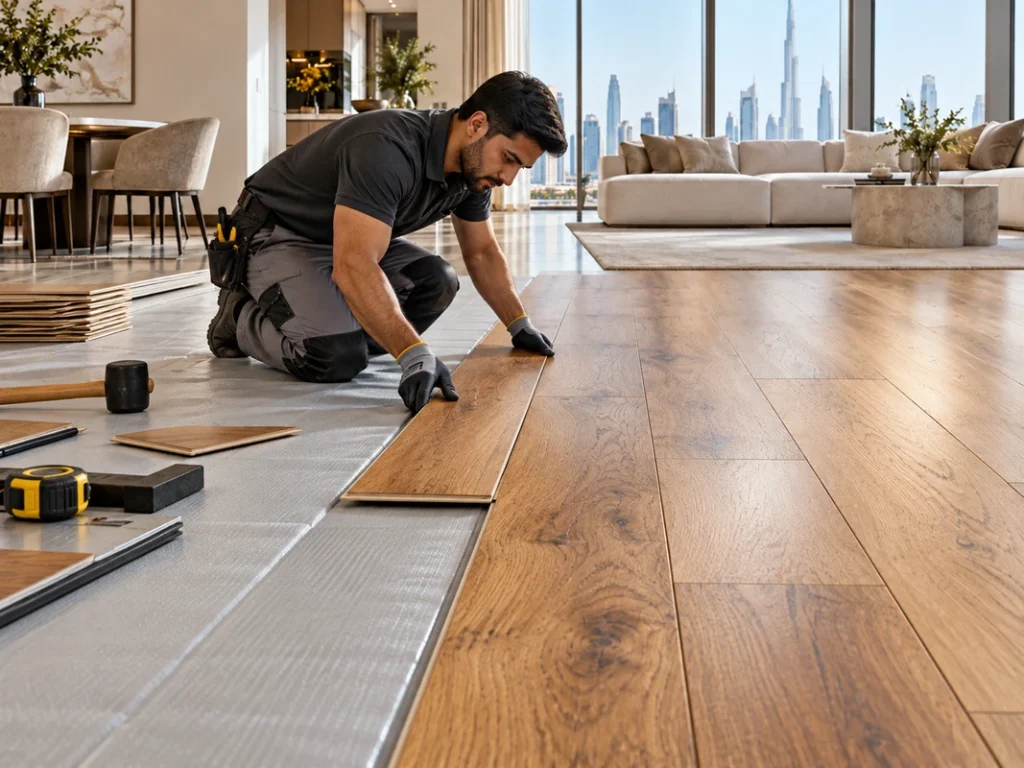
A successful vinyl flooring vs hardwood installation often depends more on the subfloor than homeowners expect.
Before installation, the contractor should check whether the concrete or existing floor is dry, stable, sufficiently flat and compatible with the chosen system. Manufacturer instructions for both vinyl and real wood set explicit requirements around subfloor condition and moisture. Karndean, for example, requires a firm, level, smooth, dry and clean subfloor for its gluedown products and specifies moisture limits for different systems.
Installing vinyl over existing tiles can sometimes avoid demolition, but only when the existing tiles are firmly bonded and the surface meets flatness and preparation requirements. A click system should not be treated as permission to cover a defective floor.
The long-term cost comparison is also more complicated than simply comparing two product prices.
As a Dubai pricing snapshot, a Floor Mart guide dated June 8, 2026, listed the following indicative figures. These figures were checked on October 10, 2026 and represent that supplier’s published planning ranges rather than a universal UAE tariff:
| Flooring | Material | Basic Installation |
|---|---|---|
| Vinyl plank / LVP | AED 35–60/m² | AED 18–25/m² |
| Standard SPC | AED 35–55/m² | AED 20–30/m² |
| Premium SPC | AED 60–85/m² | AED 25–35/m² |
| Engineered wood | AED 135–300/m² | AED 25–40/m² |
| Solid hardwood | AED 200–500/m² | AED 30–50/m² |
The same source notes that levelling, removal of existing flooring, underlay, skirting, transitions and wastage may be additional costs.
For that reason, vinyl usually wins on initial purchase cost, but wood flooring or vinyl should be compared over a defined ownership period. A lower-cost floor that needs complete replacement may eventually cost more than a repairable floor retained for longer. Conversely, paying for premium timber makes little financial sense if the property is a short-term rental where simple replacement and maintenance are more valuable.
If you are considering imported or European flooring, compare the actual construction, finish, certification, warranty and installation conditions rather than assuming geographic origin alone guarantees better performance
Which Flooring Is Best for Different Rooms in Dubai?
| Room / Situation | Recommended Option | Why | Important Condition |
|---|---|---|---|
| Living rooms | Engineered wood or quality vinyl/SPC | Wood suits premium interiors; vinyl suits easier maintenance | Consider sunlight, traffic and AC consistency |
| Bedrooms | Engineered wood or luxury vinyl | Both can provide comfortable residential finishes | Compare acoustics and underlay |
| Kitchens | Suitable vinyl/SPC often practical | Better tolerance of routine spills | Verify product and joint-system suitability |
| Bathrooms | Approved vinyl system only where permitted | Some products tolerate wet conditions better than wood | Manufacturer approval, perimeter detailing and waterproofing are essential; shower areas have different requirements |
| High-traffic areas | Commercially suitable vinyl/SPC or durable wood specification | Easier everyday maintenance or repairable timber | Check wear layer, finish and intended-use rating |
| Homes with pets | Quality vinyl/SPC or durable finished wood | Vinyl can simplify spill and scratch management | No floor is scratch-proof; claws and grit still matter |
| Rental apartments | Vinyl/SPC | Lower initial cost and easier turnover maintenance | Choose replaceable, properly specified products |
| Premium villas | Engineered wood or solid hardwood | Authentic timber and long-term renovation potential | Indoor humidity, sunlight and installation conditions must be controlled |
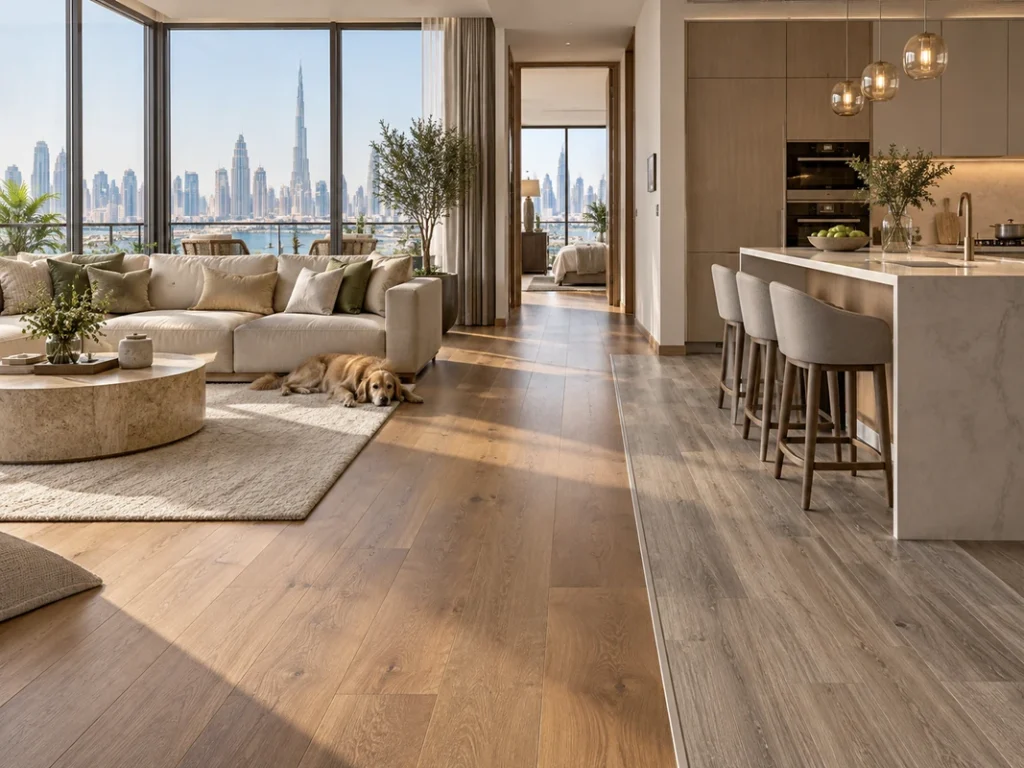
For a premium villa living room with stable air conditioning, engineered wood may provide the strongest balance between genuine timber appearance and dimensional stability. In a busy apartment or rental where fast cleaning and routine spill resistance matter more, a properly specified vinyl or SPC product can be more practical.
Bathrooms need particular caution. Do not assume that every product marketed as waterproof is suitable beside a shower or floor drain. Product approval, installation details and the underlying waterproofing system must all be checked. Quick-Step, for example, excludes certain highly humid areas and rooms with built-in drains from the conditions of some vinyl warranties

How to Choose Between Vinyl and Wood Flooring in the UAE
The most useful way to resolve vinyl vs wood flooring is to match the material to your priorities rather than search for one winner.
Choose Luxury Vinyl or SPC If:
Choose vinyl when controlling the initial budget, simplifying maintenance and handling routine spills are high priorities. It can make particular sense for rentals, family homes, high-traffic areas and renovation projects where minimising disruption matters.
Do not buy solely because a product is labelled “SPC” or “waterproof.” Check its wear layer, locking system, allowable temperature range, direct-sunlight guidance, underlay requirements and warranty.
Choose Engineered Wood If:
Choose engineered wood when you want genuine timber, a more natural premium finish and long-term residential use, but would prefer a layered construction rather than a solid plank.
It is particularly relevant to air-conditioned UAE living rooms, bedrooms and premium interiors where environmental conditions can be kept within the manufacturer’s specified range. The construction of engineered flooring does not eliminate the need for moisture testing or climate control.
Choose Solid Hardwood If:
Choose solid hardwood when solid timber itself is a priority and you value its long-term refinishing potential enough to accept stricter installation, environmental and maintenance requirements.
It is a more specialised choice for Dubai interiors and should only be specified after confirming the subfloor, expected humidity range, plank construction, installation system and manufacturer requirements.
Before purchasing either wood flooring or vinyl, check:
Are indoor temperature and relative humidity within the product’s permitted range?
Has the concrete or existing subfloor been tested for moisture and flatness?
Is the product approved for the room and expected level of direct sunlight?
Does the quotation include preparation, installation, underlay, skirting, trims and removal work?
Have you reviewed the technical data sheet, warranty and repair or replacement conditions?
Where relevant, are VOC/emissions certifications and the specifications of adhesives and underlays available?
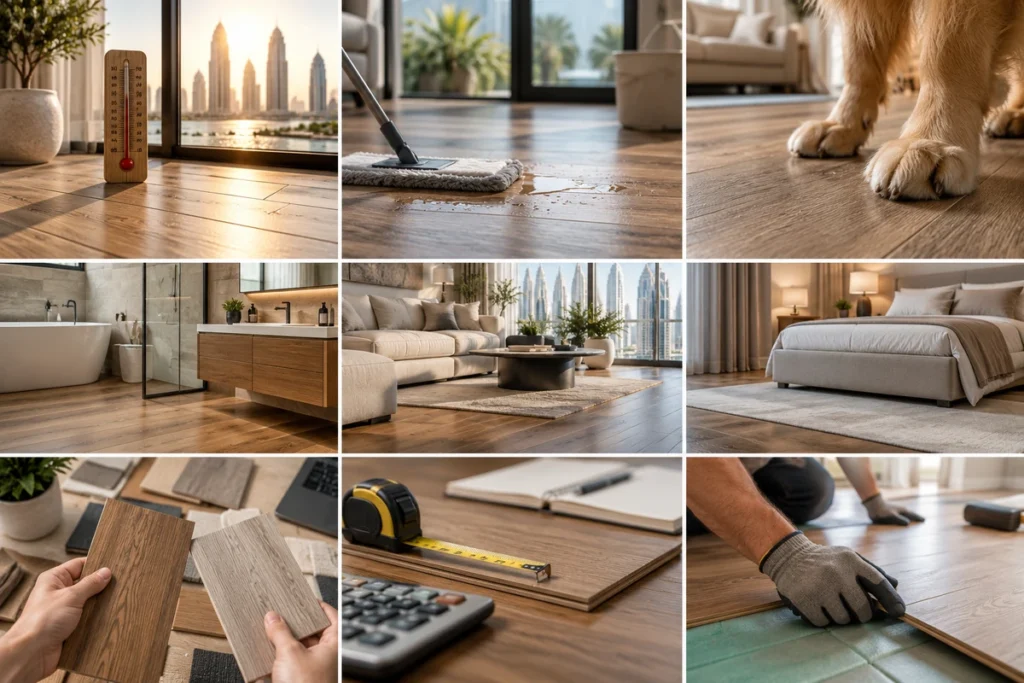
A flooring sample can also look very different under your home’s actual daylight and artificial lighting. Comparing physical samples in the intended room and obtaining a site-specific installation assessment is more useful than selecting a product from an online image alone
FAQs
Can vinyl flooring be installed over existing tiles in Dubai?
Often, yes, but only if the existing tiles are firmly bonded, dry, clean and sufficiently flat for the selected flooring system. Loose tiles, excessive grout-line variation or an uneven surface may require repair or levelling first. Always follow the flooring manufacturer’s subfloor requirements
What should be included in a flooring installation quote in the UAE?
A useful quote should identify the flooring product, measured area, material price, installation cost, subfloor preparation, underlay or adhesive, skirting and transitions, removal and disposal of existing flooring, wastage allowance, warranty terms and applicable VAT. This makes competing quotations much easier to compare accurately.
Vinyl or Wood Flooring: The Final Decision
For most buyers, the right vinyl vs wood flooring decision comes down to a trade-off. Vinyl and SPC generally offer lower entry costs and easier everyday moisture management, while engineered and solid wood provide genuine timber, natural variation and stronger renovation potential. Dubai’s climate does not automatically disqualify either category; product specifications, indoor conditions and installation quality matter more than the material name alone.
Before choosing, compare samples, technical specifications, the condition of your subfloor and a complete installed quotation. Greenwood can then help you evaluate suitable options for the actual conditions of your home rather than choosing flooring from appearance or price alone