
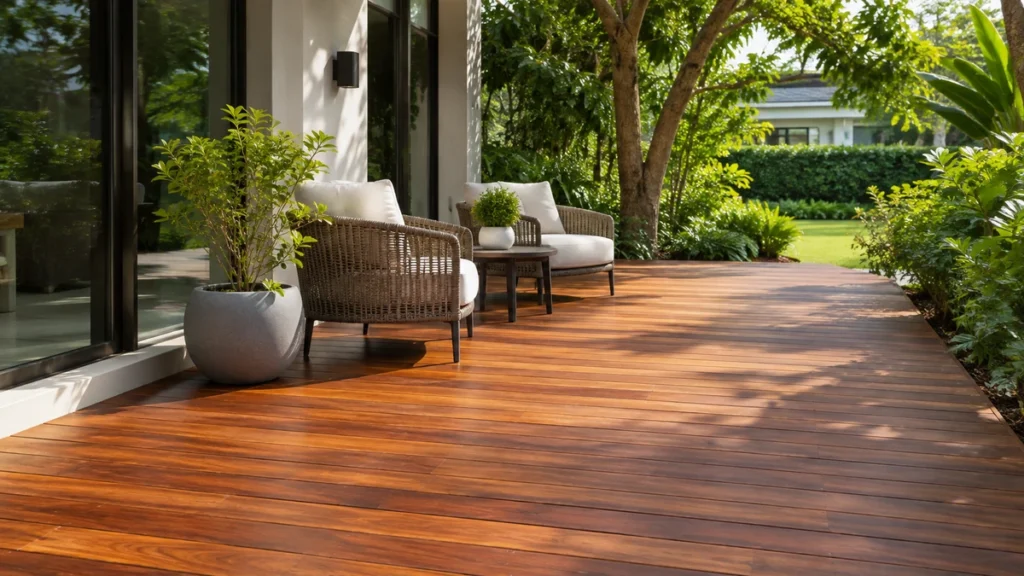
What Is the Best Wood for Outdoor Decking?
The best wood for outdoor decking depends on your climate, budget, expected foot traffic, and maintenance preferences. Iroko is an excellent all-round premium hardwood, while Ipe and Cumaru offer exceptional hardness and durability for heavily used decks. Pressure-treated pine is a practical budget choice, Accoya provides outstanding dimensional stability in wet conditions, and thermally modified wood offers improved moisture resistance. The right choice balances durability, appearance, installation requirements, and long-term maintenance rather than focusing on one characteristic
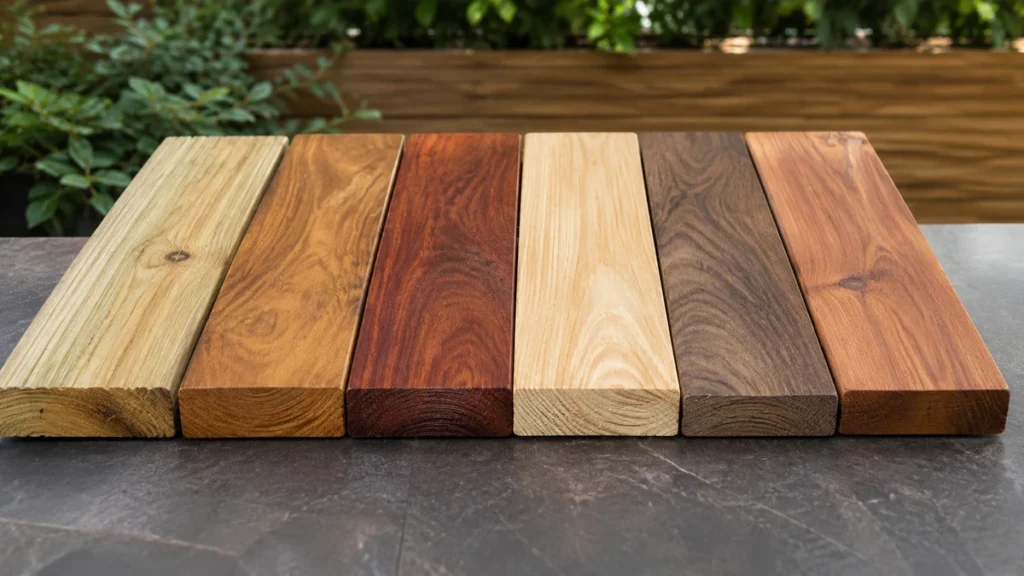
Best Outdoor Decking Woods at a Glance
Different outdoor decking wood types offer distinct advantages. This comparison highlights where each material performs best and what buyers should consider before choosing.
| Wood type | Best for | Main advantage | Main limitation |
|---|---|---|---|
| Pressure-treated pine | Budget projects | Affordable and widely available | Requires appropriate treatment and maintenance |
| Iroko | Premium residential decks | Natural durability and attractive appearance | Higher initial cost |
| Ipe and Cumaru | Heavy-use areas | Exceptional hardness and wear resistance | Difficult installation and higher cost |
| Accoya | Wet and humid climates | Excellent dimensional stability | Premium pricing |
| Thermally modified ash and pine | Reduced moisture movement | Improved stability and decay resistance | Still requires surface care |
| Cedar and redwood | Traditional garden decks | Natural appearance and easy workability | Softer surfaces prone to dents |
These recommendations describe typical material characteristics, not guaranteed performance. Board quality, installation, drainage, and exposure conditions can significantly influence how long a deck lasts.
The Best Wood Types for Outdoor Decking
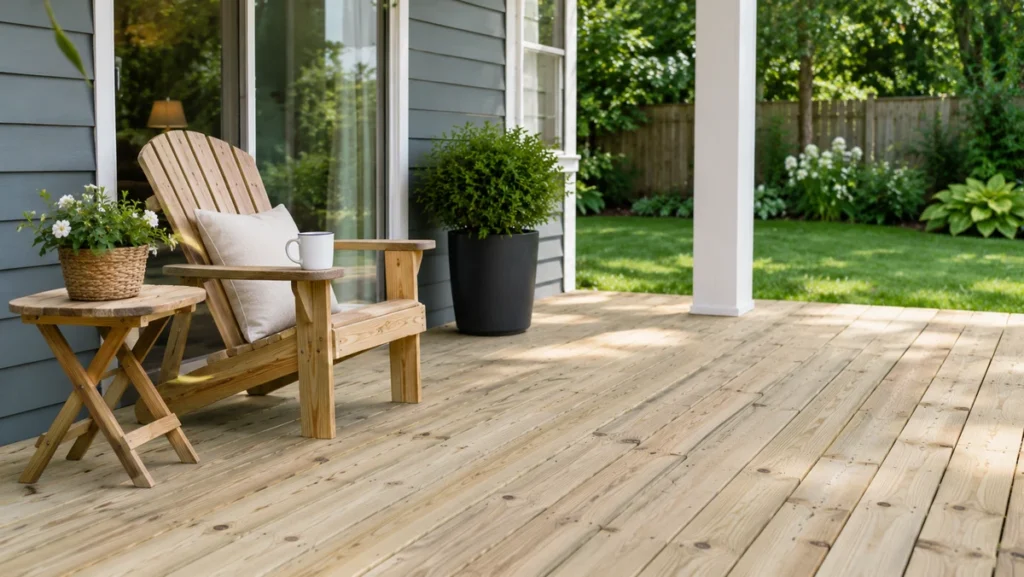
Pressure-Treated Pine – Best Budget Option
Pressure-treated pine is one of the most economical options for timber outdoor decking. Preservatives help protect the wood against fungal decay and insect damage, making properly treated boards suitable for exterior environments.
Its affordability makes pine particularly attractive for large residential decks, garden platforms, and projects with limited budgets.
However, pine is relatively soft and can develop dents, surface checks, or movement as moisture conditions change. Regular cleaning and suitable protective finishes help maintain its appearance.
Best suited for: Budget-conscious homeowners who want natural timber and are comfortable with periodic maintenance.
Always confirm that the treatment classification matches the intended exposure. Above-ground decking and structural components exposed to persistent moisture may require different treatment specifications
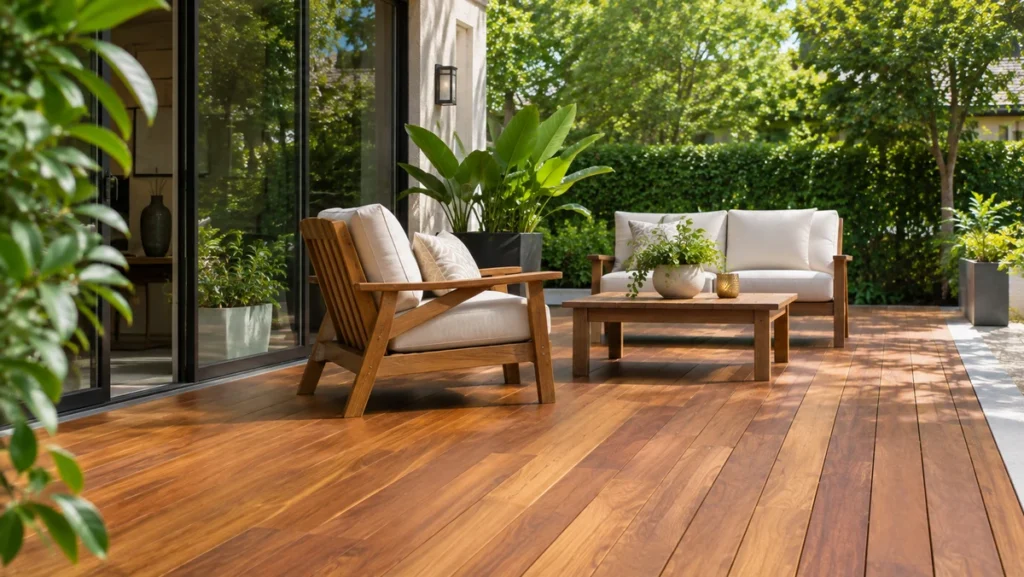
Iroko – Best All-Round Premium Hardwood
Iroko is a tropical African hardwood valued for its natural resistance to decay, attractive golden-brown appearance, and relatively good dimensional stability.
For homeowners considering iroko wood outdoor decking, its combination of durability and appearance makes it a strong alternative to more expensive tropical hardwoods.
Iroko performs well in exposed residential environments when properly installed, ventilated, and maintained. Its interlocked grain can complicate machining, while prolonged sunlight gradually changes its original colour.
An appropriate exterior finish can help preserve the desired appearance, although the wood’s natural durability does not depend entirely on decorative coatings.
Best suited for: Premium terraces, villa gardens, and poolside installations where natural aesthetics and durability are priorities.
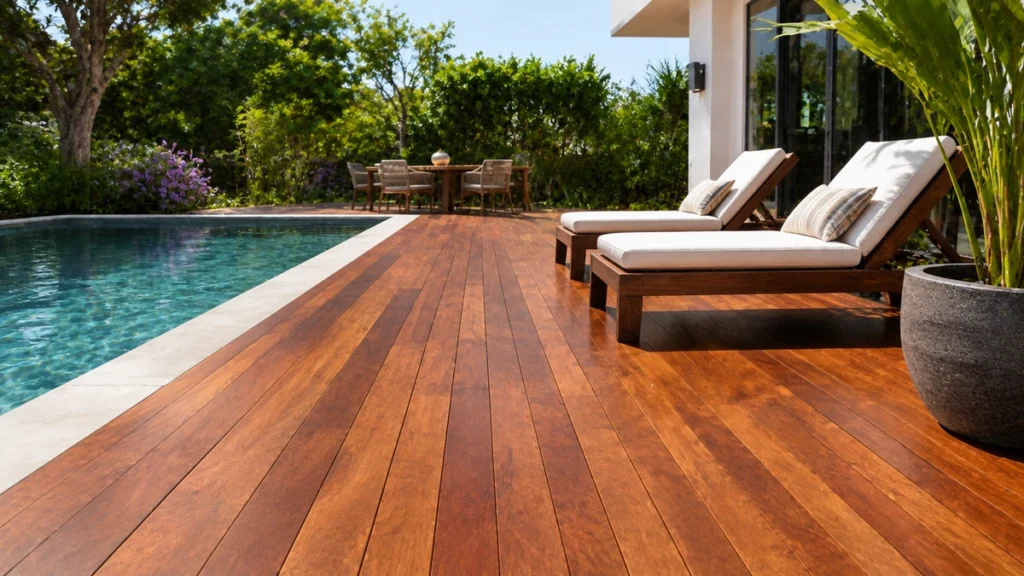
Ipe and Cumaru – Best for Durability and Heavy Use
Ipe and Cumaru are extremely dense tropical hardwoods known for outstanding resistance to wear and biological deterioration.
Their hardness makes them especially attractive for busy terraces, commercial walkways, and outdoor spaces exposed to frequent foot traffic or furniture movement.
Both species offer rich natural colours, although their density makes cutting, drilling, and fastening more demanding. Pre-drilling and suitable exterior-grade fixings are typically necessary.
These materials also involve higher purchasing and installation costs. Buyers should verify timber origin and responsible sourcing rather than assuming that exceptional durability automatically makes a product environmentally preferable.
Best suited for: High-traffic applications where surface hardness and long-term performance justify a larger investment
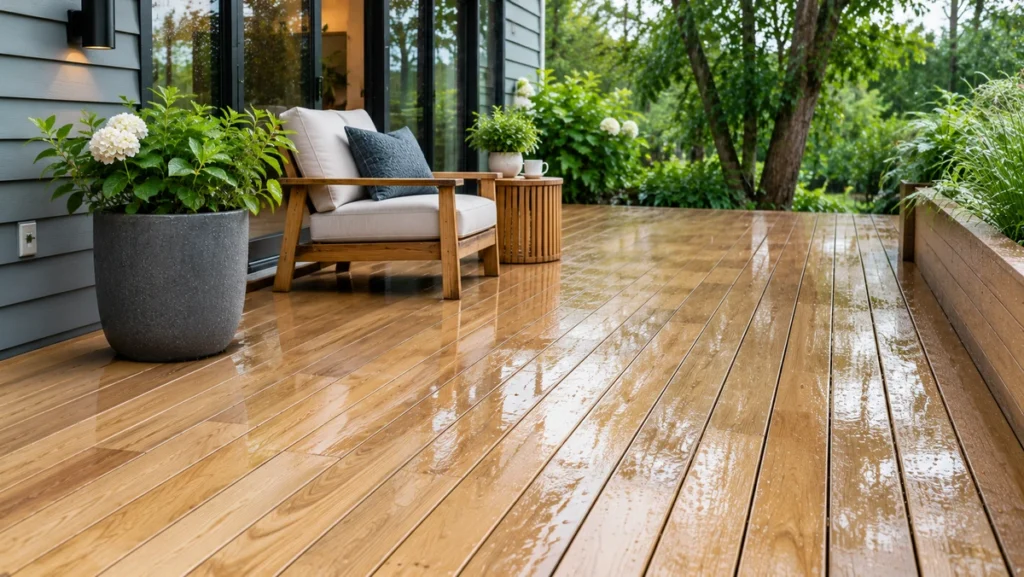
Accoya – Best for Stability in Wet Climates
Accoya is acetylated wood, typically produced from radiata pine through a modification process that significantly reduces its tendency to absorb moisture and change dimensions.
This makes Accoya particularly useful where decking experiences repeated wetting, humidity fluctuations, or demanding weather conditions.
Its excellent dimensional stability helps minimise swelling, shrinking, and distortion. Accoya also provides strong resistance to fungal decay without relying on conventional pressure-preservative treatment.
Although its initial price is relatively high, reduced movement can lower maintenance demands and help exterior finishes remain effective longer.
Accoya still requires cleaning, and an appropriate finish is necessary if retaining a particular colour is important.
Best suited for: Humid gardens, exposed terraces, and moisture-prone environments where dimensional stability is a primary concern
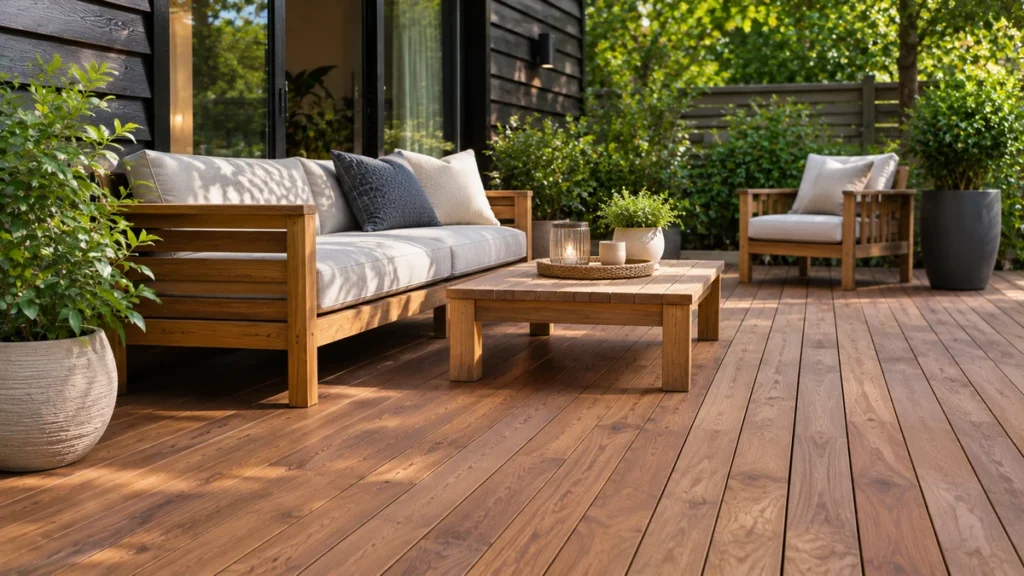
Thermally Modified Ash and Pine – Best for Lower Upkeep
Thermally modified wood undergoes controlled heating that changes its moisture behaviour and improves dimensional stability and resistance to decay.
Thermally modified ash offers an attractive hardwood appearance, while modified pine provides a potentially more affordable alternative.
These products can work well for modern terraces and architectural decking where reduced swelling and shrinking are desirable.
However, thermal modification does not make wood maintenance-free. Untreated surfaces generally weather towards grey, and suitable coatings may be needed to preserve their original colour.
Performance also varies by species, treatment process, and product classification. Choose boards specifically approved for exterior decking rather than assuming every thermally modified product is suitable.
Best suited for: Homeowners seeking a natural timber appearance with reduced moisture-related movement
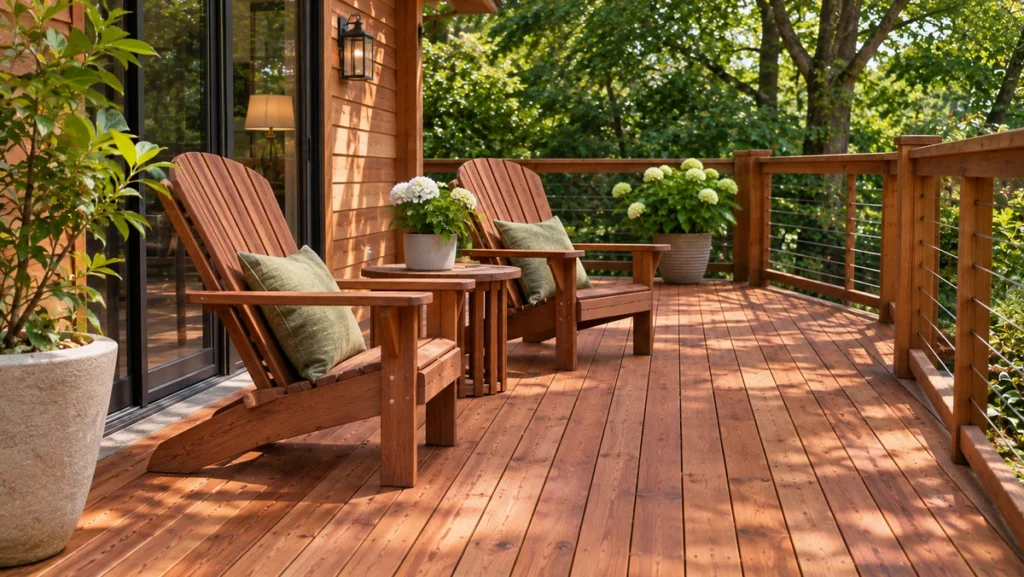
Cedar and Redwood – Best for a Natural, Traditional Look
Cedar and redwood are popular for their warm colours, distinctive grain, and traditional appearance.
Both are relatively lightweight and easy to machine, making them attractive for garden decks, patios, and residential landscaping.
Durable heartwood can offer useful natural decay resistance, although performance varies with species, growth conditions, and the proportion of sapwood.
Their main limitation is softness. Compared with dense tropical hardwoods, cedar and redwood are more susceptible to dents, scratches, and damage from heavy furniture.
They also weather naturally when exposed to sunlight and moisture.
Best suited for: Traditional gardens and lower-traffic residential spaces where appearance and workability matter more than maximum surface hardness
How to Choose the Right Timber for Outdoor Decking
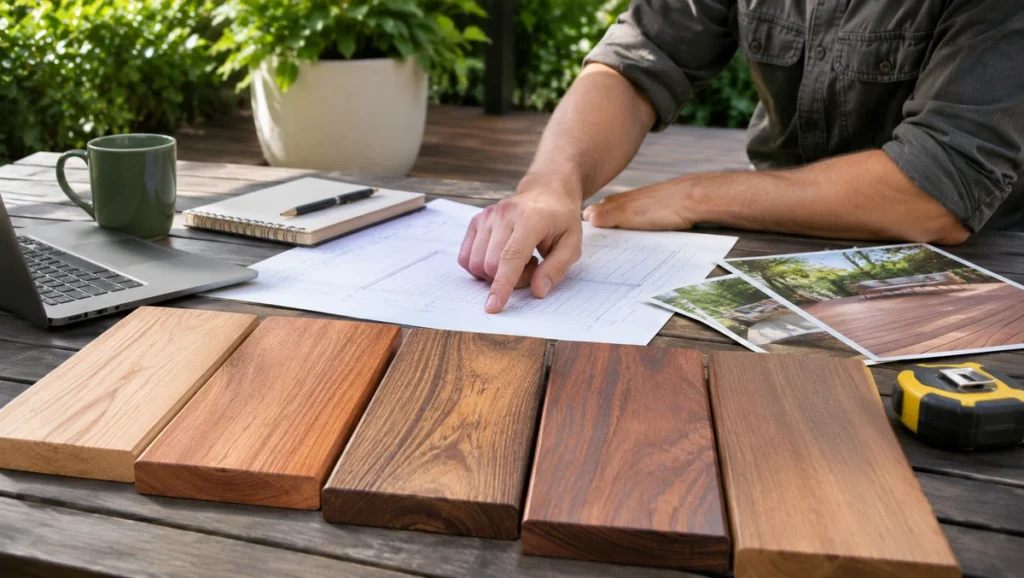
Choosing suitable decking timber requires evaluating more than its colour or purchase price.
1. Assess climate exposure. Consider rainfall, humidity, temperature changes, direct sunlight, and whether the deck remains shaded or frequently wet. Moisture resistance and dimensional stability become particularly important in demanding conditions.
2. Match hardness to intended use. Dense hardwoods are generally better suited to heavy furniture and frequent traffic. Softer species may be entirely adequate for quieter residential areas.
3. Consider maintenance expectations. Naturally durable timber still needs cleaning. Preserving its original colour may require periodic finishing, regardless of its resistance to decay.
4. Evaluate installation requirements. Check ventilation, substructure durability, board spacing, fastening methods, and drainage. Poor installation can undermine even premium hardwood decking.
5. Compare total ownership costs. Include substructure materials, installation labour, protective treatments, maintenance, and potential board replacement rather than comparing purchase prices alone.
A well-designed outdoor decking system must drain effectively and allow adequate ventilation. Timber decking guidance also emphasises suitable board gaps and exterior-rated fixings to accommodate movement and moisture exposure
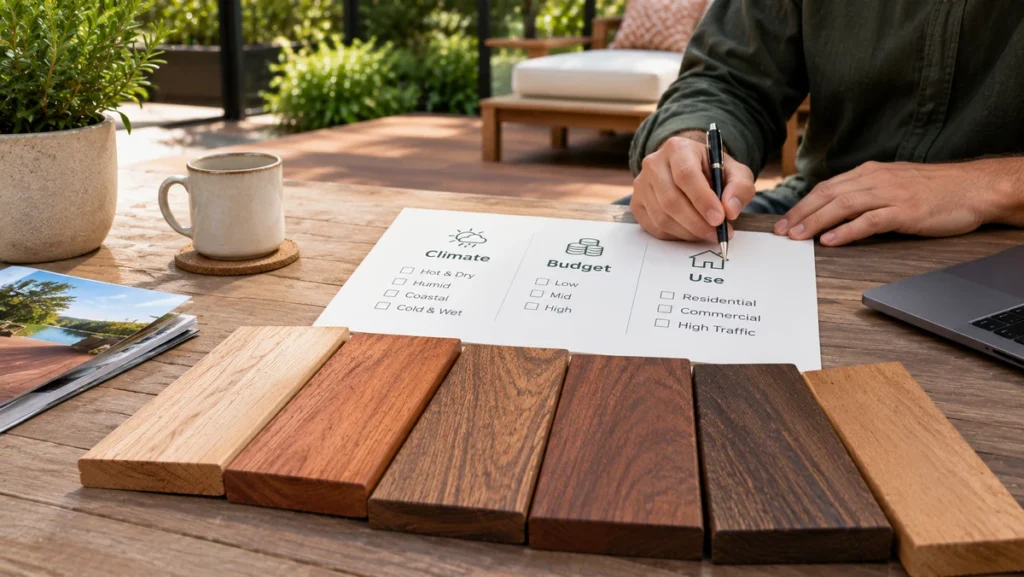
Which Decking Wood Is Best for Your Climate, Budget and Use?
For hot, sunny climates, including Dubai and other Gulf locations, Iroko, Ipe, and Cumaru are worth considering because of their natural durability. However, exposed surfaces can become uncomfortable under intense sunlight, particularly darker boards. Test representative samples under actual site conditions before choosing.
For wet or humid locations, Accoya is particularly attractive because of its dimensional stability. Properly specified durable hardwoods and exterior-rated thermally modified timber are also possibilities, provided the deck has effective drainage and ventilation.
For limited budgets, pressure-treated pine usually offers the most accessible entry point. Where long-term appearance and reduced replacement risk are more important than initial cost, premium hardwoods or modified timber may justify further consideration.
For poolside and heavily used spaces, prioritise durability, surface condition, drainage, and verified wet-slip performance. No timber species is automatically slip-proof, and grooved boards should not be assumed safer than smooth boards without appropriate testing.
Buyers exploring european decking collections should also confirm the actual timber species, treatment process, and exterior-use specifications. Geographic origin alone does not establish durability
Wood vs Composite Decking: Which Is Better for You?
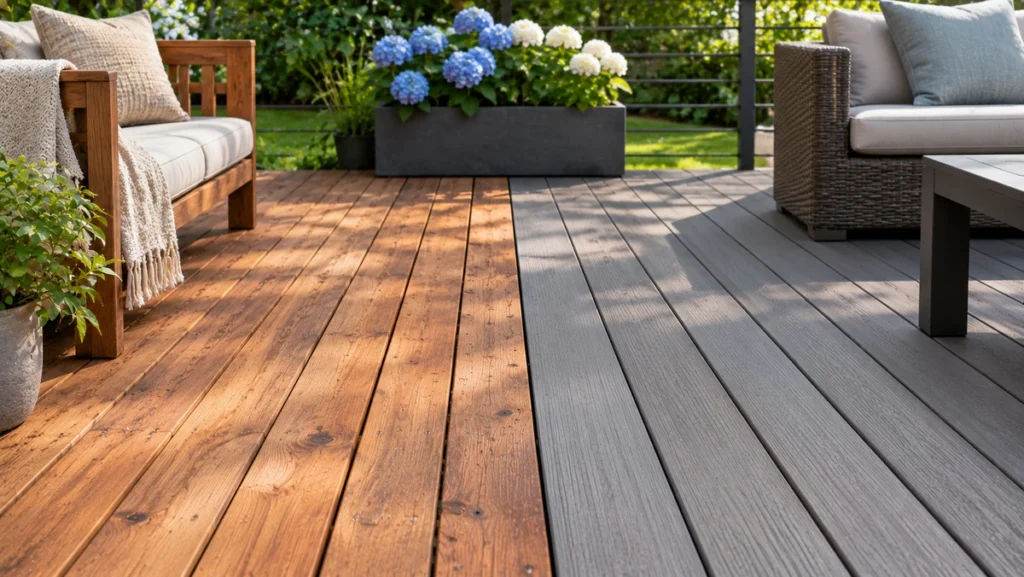
Natural wood and composite decking serve similar purposes but offer different ownership experiences.
| Factor | Natural wood decking | Composite decking |
|---|---|---|
| Appearance | Authentic grain and natural variation | Manufactured finishes, often wood-look |
| Maintenance | Cleaning and potentially periodic finishing | Cleaning; generally no routine oiling |
| Weathering | Natural colour changes and possible movement | Product-dependent fading and expansion |
| Durability | Depends strongly on species and installation | Depends on formulation and product quality |
| Surface repairs | Some boards can be refinished | Repair options depend on construction |
| Initial cost | Wide range from pine to premium hardwood | Varies by product and performance grade |
Choose natural wood if authentic texture, the possibility of refinishing, and the character of timber are priorities.
Choose composite decking if avoiding routine staining or oiling is more important, while accepting a manufactured appearance and product-specific limitations.
Neither option is universally superior. Composite boards can still require cleaning, become hot in sunlight, and undergo thermal expansion. Natural timber can deliver excellent performance when the species and installation are appropriate.
Importantly, conventional interior wooden flooring should not be substituted for exterior decking unless its manufacturer explicitly approves the product for exposed outdoor use
FAQs
What is the longest-lasting wood for outdoor decking?
Ipe and Cumaru are among the most durable natural hardwood options, offering excellent decay and wear resistance. However, service life depends on installation, moisture exposure, maintenance, and timber quality. Accoya is another strong option where dimensional stability and resistance to decay are priorities
Is Iroko better than Ipe for outdoor decking?
Iroko can be a more practical all-round choice for residential projects because it combines durability, attractive grain, and easier workability. Ipe is considerably harder and may be preferable for intensive foot traffic. The better option depends on the application and available budget
Does outdoor wood decking need sealing or oiling?
Not always for structural durability. Naturally durable and appropriately modified wood can perform without decorative finishes, but oiling or coating may help retain colour and improve surface appearance. Follow the timber supplier’s maintenance recommendations
Which decking wood is best for a swimming pool area?
Iroko, Accoya, and other suitably specified durable decking products are worth considering. Focus on moisture exposure, safe surface temperatures, drainage, and tested slip resistance rather than choosing solely by species
Can outdoor timber decking last without regular maintenance?
Timber may remain structurally sound for many years without frequent refinishing, depending on its durability and exposure. However, all decks need periodic cleaning and inspection to control debris, algae, loose fixings, and potential slip hazards
conclusion
The best decking wood is the one that matches your specific environment and priorities. Iroko offers an appealing balance for premium residential projects, Ipe and Cumaru suit demanding applications, Accoya excels where stability matters, and treated pine remains an economical choice. Before selecting a material, compare actual product specifications, installation conditions, and maintenance expectations. Greenwood can help you explore appropriate decking options for your outdoor space