
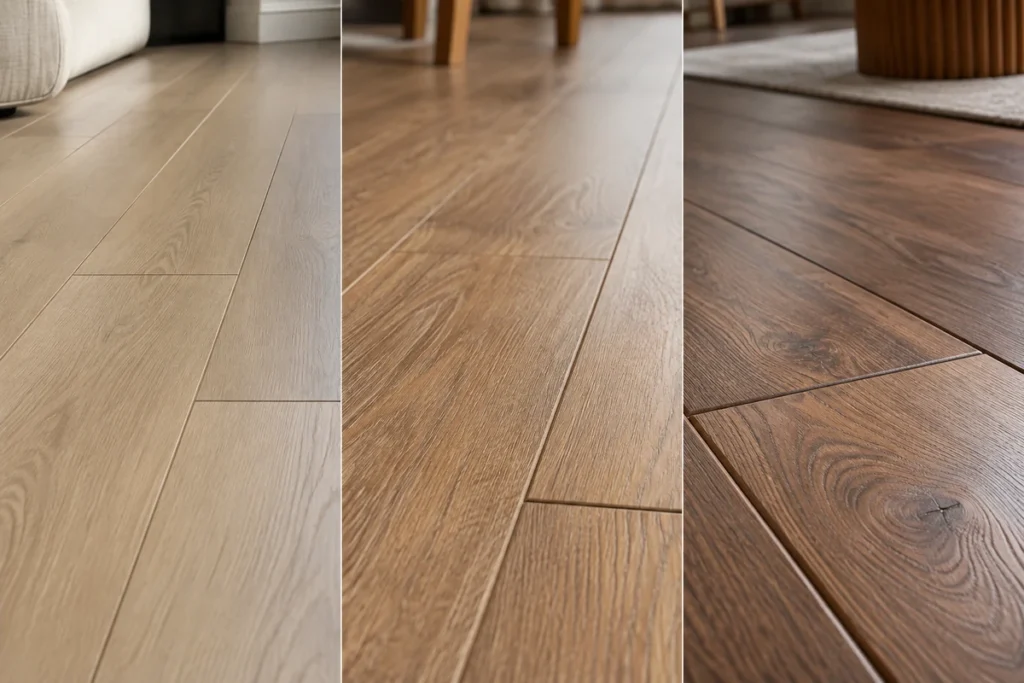
Bevelled Edge Flooring: Types, Pros & Cons vs Square Edge
Choosing the right flooring involves more than selecting a colour, texture, or material. The way each plank is finished along its edges can significantly influence the appearance of the entire floor.
Beveled edge flooring features slightly angled plank edges that create visible grooves between adjoining boards. These grooves define individual planks, producing a more pronounced wood-floor appearance. Square-edge flooring, by comparison, creates a smoother surface with less noticeable joints.
Which is better? Bevelled edges are generally preferable when you want visible plank definition and a natural wood-inspired design. Square edges suit interiors where a seamless appearance is the priority. Micro-bevelled edges offer a balance between these two styles.
Understanding their differences can help homeowners in Dubai and across the UAE choose flooring that suits their interior design, cleaning preferences, and everyday needs
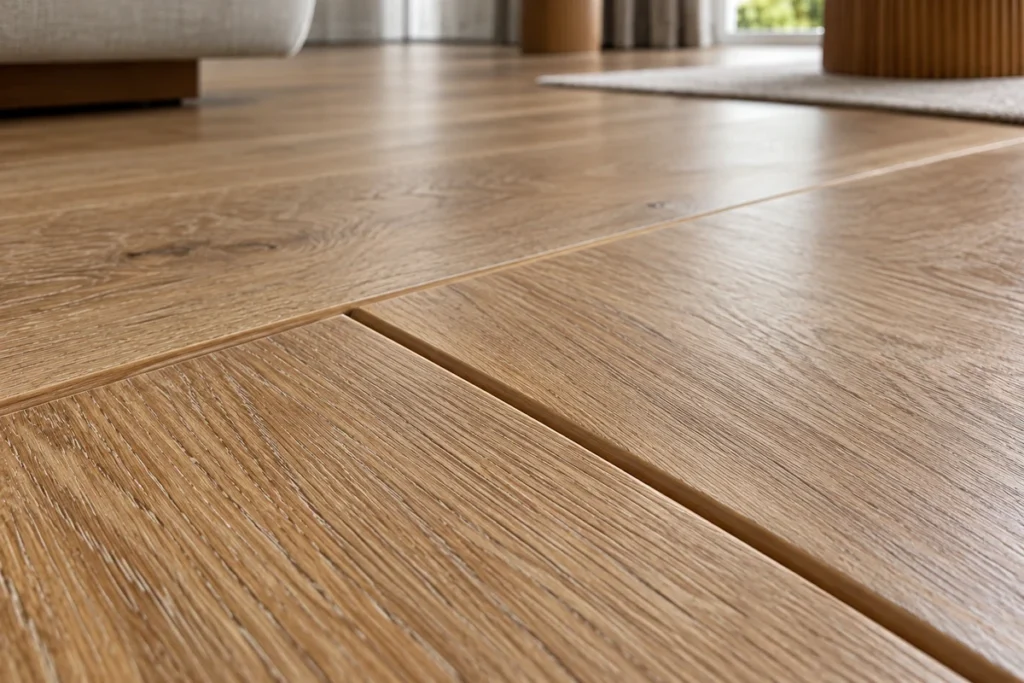
What Is Bevelled Edge Flooring?
Bevelled edge flooring is a flooring design in which the upper edges of individual planks are slightly angled or chamfered, creating a visible groove where two boards meet.
Unlike square-edge boards, which have straight edges designed to meet with minimal visible separation, bevelled planks emphasise the outline of each board.
When two bevelled edges meet, they commonly form a shallow V-shaped groove. This is why the design is frequently called V-groove flooring.
The depth and visibility of these grooves depend on the manufacturer’s edge profile.
Bevelled edges are commonly found in laminate flooring, but they also appear in wooden flooring products, including engineered wood and solid hardwood.
Their primary purpose is aesthetic: creating plank definition, highlighting wood-grain designs, and adding visual texture to a room.
For example, a wide-plank oak-effect floor with bevelled edges can make individual boards more noticeable, creating an appearance similar to traditional timber flooring.
However, a bevelled edge does not automatically make flooring stronger, more water-resistant, or easier to install. These characteristics depend on the material, surface protection, joint construction, and installation system
Laminate Flooring Edge Types: Square, Micro-Bevel & Full Bevel
The three main laminate flooring edge types are square edge, micro-bevel, and full bevel. Each creates a different appearance, even when the flooring colour and plank dimensions are identical.
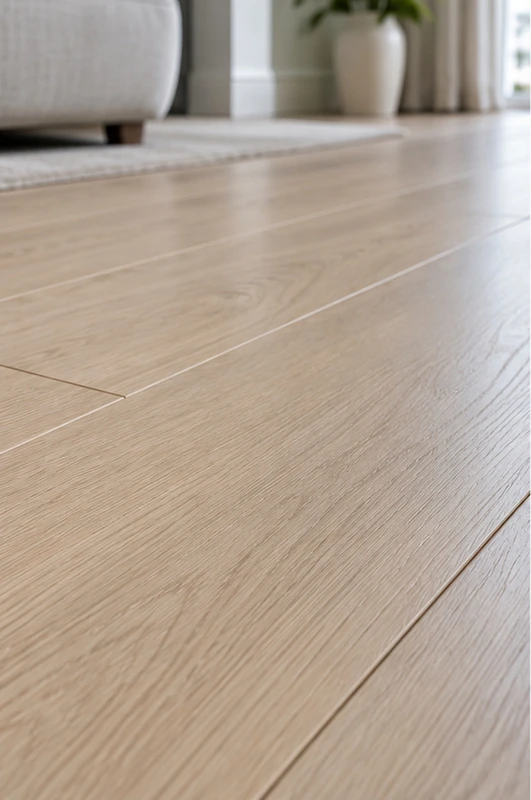
Square Edge Flooring
Square-edge flooring features straight, unchamfered upper plank edges. Once properly installed, adjoining boards meet with minimal visible grooves.
This produces a continuous surface where the flooring pattern receives more attention than individual plank boundaries.
Advantages: Square edges create a clean, contemporary appearance and leave fewer recessed areas where dust can accumulate. They work particularly well in minimalist interiors.
Disadvantages: Individual boards are less visually defined, making the floor appear more uniform. The appearance can also make slight variations in joint alignment noticeable.
Square-edge laminate is a suitable option for modern apartments, offices, and interiors that prioritise uninterrupted flooring patterns.
However, square edges do not guarantee invisible joints. Manufacturing tolerances, lighting, installation quality, and environmental movement can still affect their visibility
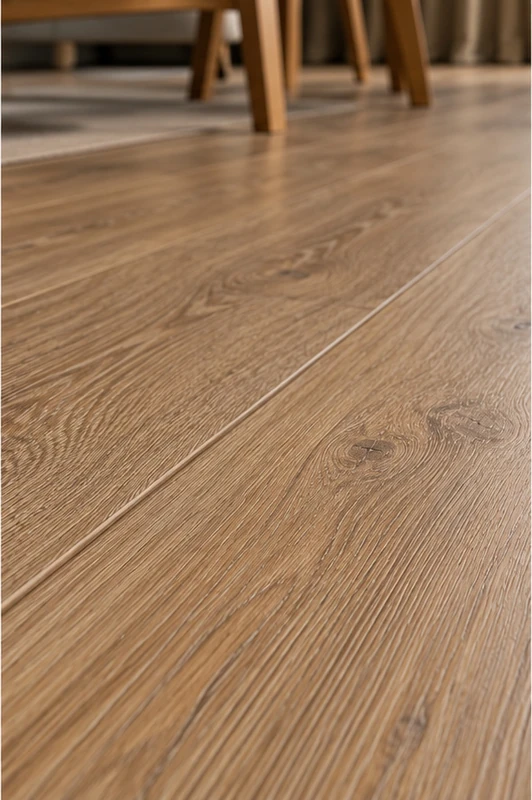
Micro-Bevelled Edge Flooring
Micro bevel flooring features a very small chamfer along the upper edges of each plank.
The resulting groove is shallower and less noticeable than a traditional full bevel.
This creates subtle plank separation without dramatically interrupting the overall floor design.
Advantages: Micro-bevelled edges provide a balanced appearance, combining the visual definition of bevelled planks with the understated finish of square edges.
Their relatively shallow grooves can also be easier to maintain than deeper decorative profiles.
Disadvantages: They offer less pronounced plank definition than full-bevel flooring and are not completely seamless.
Micro-bevelled flooring is particularly suitable for contemporary residential interiors where homeowners want a realistic timber-inspired appearance without strong grooves
Full Bevelled Edge Flooring
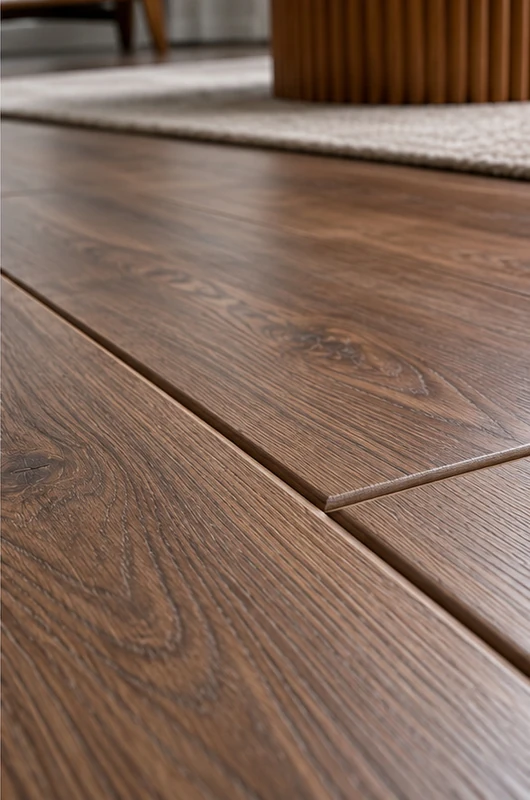
Full-bevelled flooring features more pronounced angled edges that create deeper or wider visible grooves between adjacent boards.
These grooves emphasise the length and shape of individual planks, giving the floor a more traditional, clearly defined appearance.
Advantages: Full bevels highlight individual boards, complement textured wood designs, and create stronger visual depth.
They are particularly effective with wide planks, rustic oak finishes, and interiors inspired by traditional European flooring styles.
Disadvantages: More pronounced grooves may collect slightly more dust and require additional attention during cleaning.
Full bevels are therefore most suitable when plank definition is an important part of the intended design.
What do 2V and 4V mean?
These terms describe how many sides of a plank have bevelled edges:
- 2V: Bevels on two opposite sides, typically the long edges, emphasising continuous plank lines.
- 4V: Bevels on all four sides, outlining each individual plank more completely.
Neither configuration is automatically more durable. The distinction primarily concerns appearance.
Also, bevel dimensions are not universally standardised. A micro-bevel from one manufacturer may look different from another, so checking actual flooring samples is advisable
Bevelled vs Square Edge Flooring: Key Differences
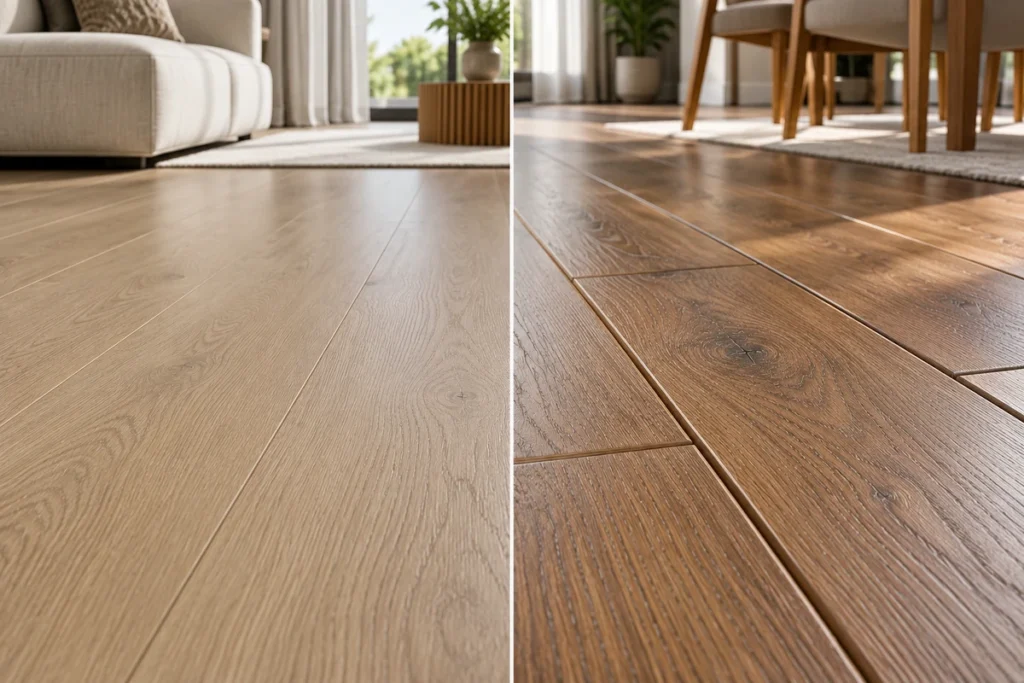
The main difference between bevelled vs square edge flooring is the visibility of plank joints. Bevelled edges intentionally define individual boards, while square edges create a more continuous surface.
However, the choice can also influence cleaning convenience, overall appearance, and how flooring complements surrounding furniture
| Feature | Square Edge | Micro-Bevel | Full Bevel |
|---|---|---|---|
| Edge design | Straight edges | Very small chamfer | Pronounced chamfer |
| Joint visibility | Minimal | Subtle | Clearly visible |
| Appearance | Smooth and uniform | Balanced and refined | Defined individual planks |
| Wood-like character | Depends mainly on surface design | Subtle plank definition | Stronger plank definition |
| Dust accumulation | Fewer recessed areas | Minimal shallow grooves | More noticeable grooves |
| Cleaning | Generally straightforward | Generally straightforward | May need additional attention |
| Best interior style | Minimalist and modern | Contemporary and transitional | Traditional, rustic, and natural |
| Water resistance | Product-dependent | Product-dependent | Product-dependent |
| Installation | Depends on locking system | Depends on locking system | Depends on locking system |
Square-edge flooring often suits spaces where visual simplicity matters. Bevelled edges offer additional definition, particularly when combined with realistic wood textures.
Micro-bevelled flooring provides a practical compromise for homeowners who appreciate both appearances.
Importantly, the edge profile alone cannot determine a floor’s overall quality. A well-manufactured full-bevel laminate may outperform a lower-quality square-edge product in durability and moisture protection.
Material construction, surface performance, and manufacturer specifications remain more important than the edge shape itself
Do Bevelled Edges Affect Cleaning, Water Resistance or Installation?
Bevelled edges can influence everyday maintenance, but their effect on water resistance and installation is often misunderstood.
The three factors should be considered separately.
Cleaning
Bevelled flooring is not inherently difficult to clean.
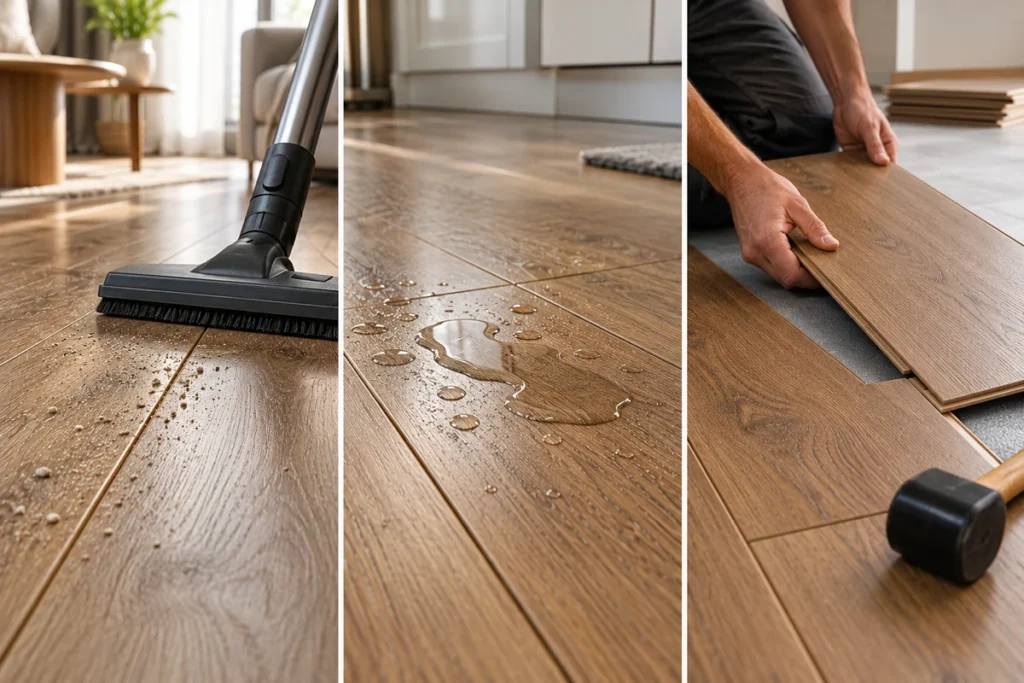
However, deeper grooves can collect fine dust, sand, and other small particles more readily than a flat-looking square-edge surface.
This consideration is relevant in Dubai, where sand and airborne dust can enter homes through doors, windows, and footwear.
For routine cleaning, use a vacuum with a suitable hard-floor attachment or a soft-bristled brush to remove particles from plank joints.
Follow with a lightly damp microfibre mop when permitted by the flooring manufacturer.
Avoid excessive water, abrasive cleaning equipment, and steam cleaners unless explicitly approved for the product.
Micro-bevelled and square-edge floors may require less attention around joints, but all three profiles can remain manageable with regular maintenance.
Water Resistance
Bevelled edges do not automatically make laminate flooring less water-resistant.
Moisture performance depends primarily on the flooring’s construction, locking joints, edge treatment, surface protection, and manufacturer-approved installation details.
Some modern laminate systems include water-repellent technologies that protect the bevelled areas.
For example, Pergo describes its AquaSafe technology as extending protection into the bevels, while Quick-Step specifies HydroSeal protection on selected bevelled laminate collections
However, water-resistant does not necessarily mean waterproof under every condition.
Prolonged standing water, damaged joints, or improper installation may still cause problems.
For kitchens, entrances, and other moisture-prone areas, prioritise verified product specifications rather than assuming one edge design provides better protection.
Installation
The edge shape generally does not determine installation difficulty.
Instead, installation depends on the product’s locking mechanism, subfloor preparation, plank dimensions, and manufacturer requirements.
Both bevelled and square-edge laminate products may use click-lock installation systems.
Bevelled edges should not be treated as a solution for uneven subfloors or poorly connected boards.
Similarly, visible grooves do not eliminate the need for appropriate expansion gaps or moisture-control measures.
In UAE properties, maintaining suitable indoor conditions and following the manufacturer’s acclimatisation and installation instructions are particularly important.
The same principle applies when comparing laminate with engineered flooring: the material’s installation requirements matter more than whether its edges are bevelled
Which Flooring Edge Type Should You Choose?
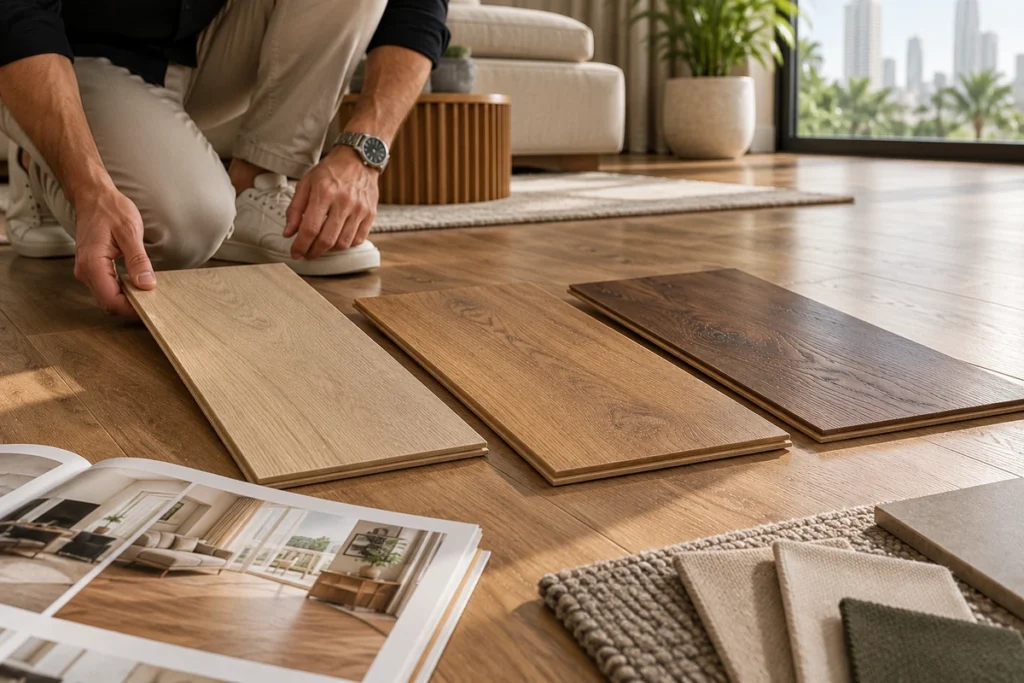
The best edge profile depends on your preferred appearance, cleaning expectations, and the atmosphere you want to create.
For most homeowners, the decision becomes easier when flooring is considered alongside room size, furniture, lighting, and architectural style.
Choose square-edge flooring if:
You prefer a clean, understated design with minimal visible plank separation.
Square edges complement modern apartments, minimalist offices, and interiors with smooth surfaces and simple furniture.
They are also worth considering when straightforward cleaning is a priority.
Choose micro-bevelled flooring if:
You want individual planks to remain distinguishable without creating prominent grooves.
Micro-bevels work particularly well in contemporary living rooms and bedrooms, offering a subtle wood-inspired finish.
They are a versatile middle ground between square and full-bevel designs.
Choose full-bevelled flooring if:
You want clearly defined planks and a stronger natural timber appearance.
Full bevels complement traditional interiors, textured oak-effect floors, and spaces where the flooring itself contributes to the room’s character.
For Dubai villas featuring warm wood tones, natural textures, or rustic design elements, this profile can be especially appealing
Final Recommendation
For a contemporary home, micro-bevelled flooring is often a sensible starting point because it combines visible plank definition with a relatively subtle finish.
Choose square edges when seamless visual continuity is your priority, or full bevels when pronounced plank outlines better match your design.
Before purchasing, compare physical samples under your room’s actual lighting. Grooves that look subtle in a showroom may appear more noticeable when illuminated from the side.
Also check the flooring’s wear rating, moisture-resistance claims, warranty, and installation requirements.
If you are still comparing materials, our guide, What Is Laminate Flooring?, explains laminate construction and its key characteristics before you explore specific edge designs.
Ultimately, beveled edge flooring should be selected for the appearance it creates rather than assumptions about performance.
Whether you prefer a seamless square edge, a subtle micro-bevel, or a pronounced V-groove, the right choice should complement your interior while meeting your practical requirements. Greenwood offers flooring options that can help homeowners across Dubai and the UAE find a suitable balance between design and everyday functionality