
Engineered Wood Flooring and Underfloor Heating
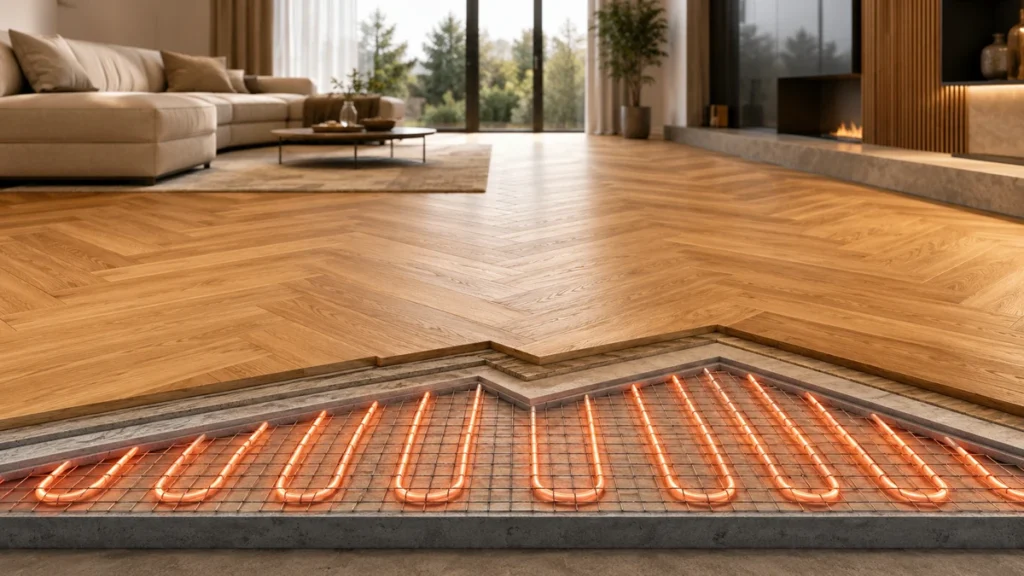
Yes, you can use underfloor heating under engineered wood flooring, but only when the flooring is approved for UFH, installed correctly, and controlled with the right temperature limits. Engineered wood is usually a better choice than solid wood because its layered construction gives it more dimensional stability when temperature and humidity change. The main rule is simple: the floor surface temperature should not exceed the manufacturer’s limit, commonly 27°C. Leading wood flooring manufacturers such as Kährs and Junckers also refer to this 27°C maximum surface temperature for wood floors over underfloor heating.
For homeowners, designers, and contractors, the real question is not just “Can it be done?” The better question is: “Which engineered wood floor is safe, efficient, and stable over a heated subfloor?”
Can You Use Underfloor Heating Under Engineered Wood Flooring?
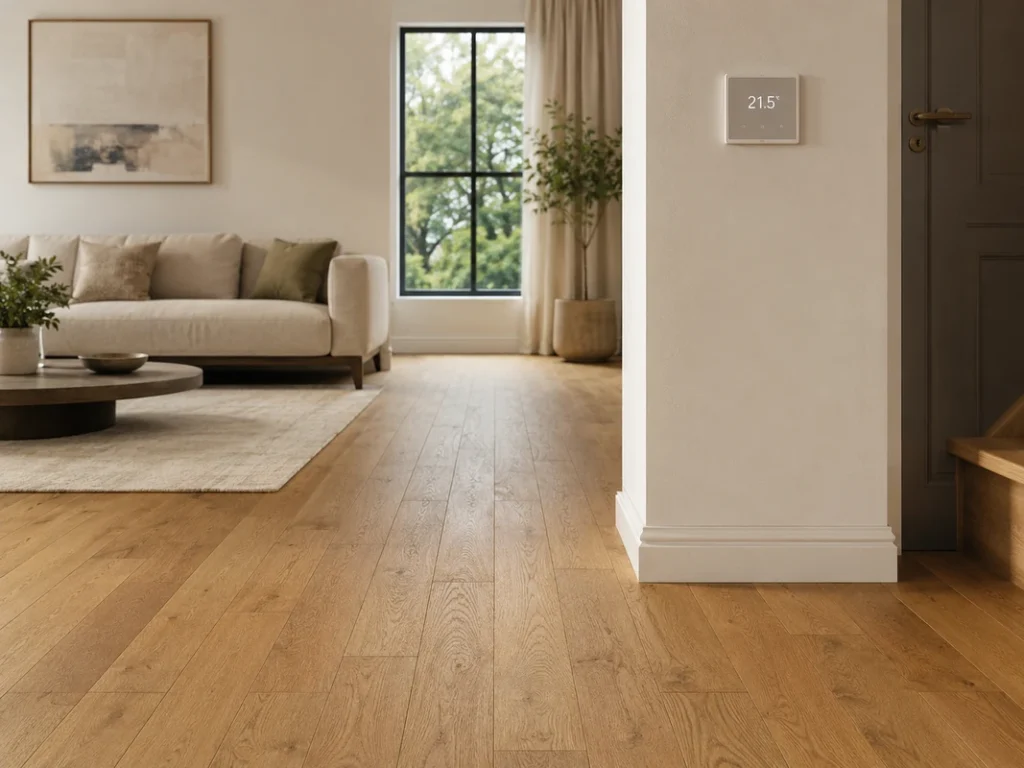
Underfloor heating under engineered wood is safe when the flooring, heating system, subfloor, adhesive or underlay, and thermostat are all compatible. This is not a place to guess. If the board is not approved by the flooring manufacturer for underfloor heating, do not install it over UFH.
Engineered wood flooring underfloor heating works best when heat is distributed evenly across the floor. Sudden heat spikes, poor subfloor preparation, trapped moisture, and incorrect installation can all cause movement, gaps, cupping, cracking, or finish damage. A good UFH installation is controlled, gradual, and stable.
The safest approach is to check three things before buying: the flooring technical sheet, the heating system instructions, and the installer’s method. If these three do not agree, stop. That floor may look nice in the showroom, but it can become an expensive problem after the heating starts
The Safe Temperature Limit for Engineered Wood Flooring Over UFH
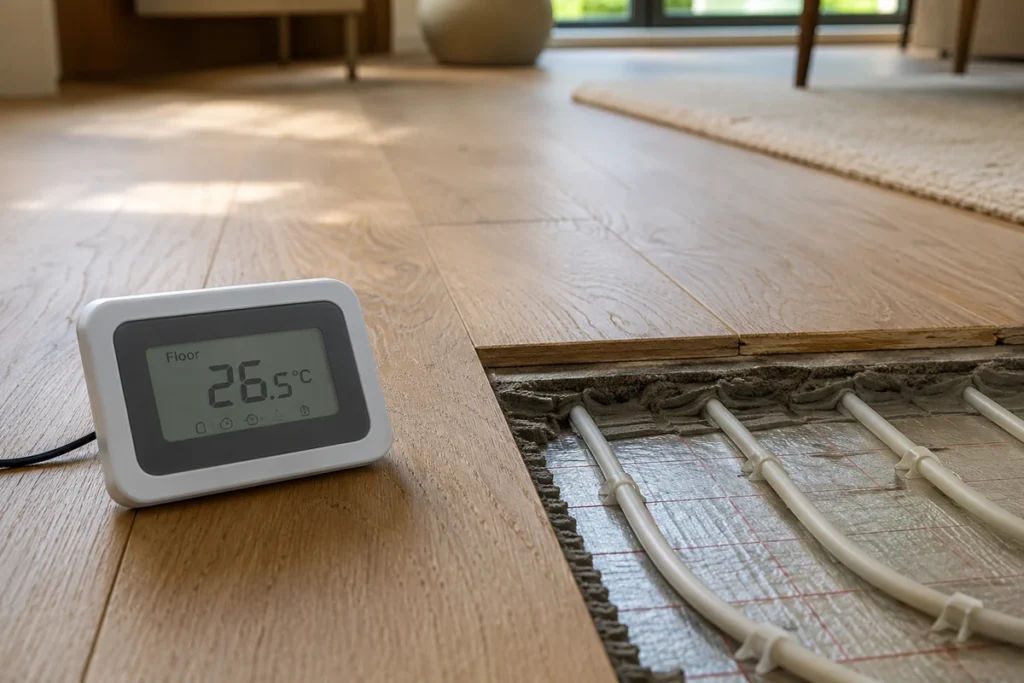
The most important temperature is the floor surface temperature, not just the thermostat setting on the wall. Many wood flooring guides use 27°C as the common maximum floor surface temperature, but you should always follow the specific flooring manufacturer’s limit because some products may require a lower maximum. Kährs states that the floor surface temperature must never exceed 27°C, including areas under rugs, furniture, and near heating elements.
The heating should also be increased gradually. Do not shock the floor by turning the system from cold to high heat in one jump. Wood responds better to slow and steady temperature changes
Why the Floor Surface Temperature Matters More Than Room Temperature
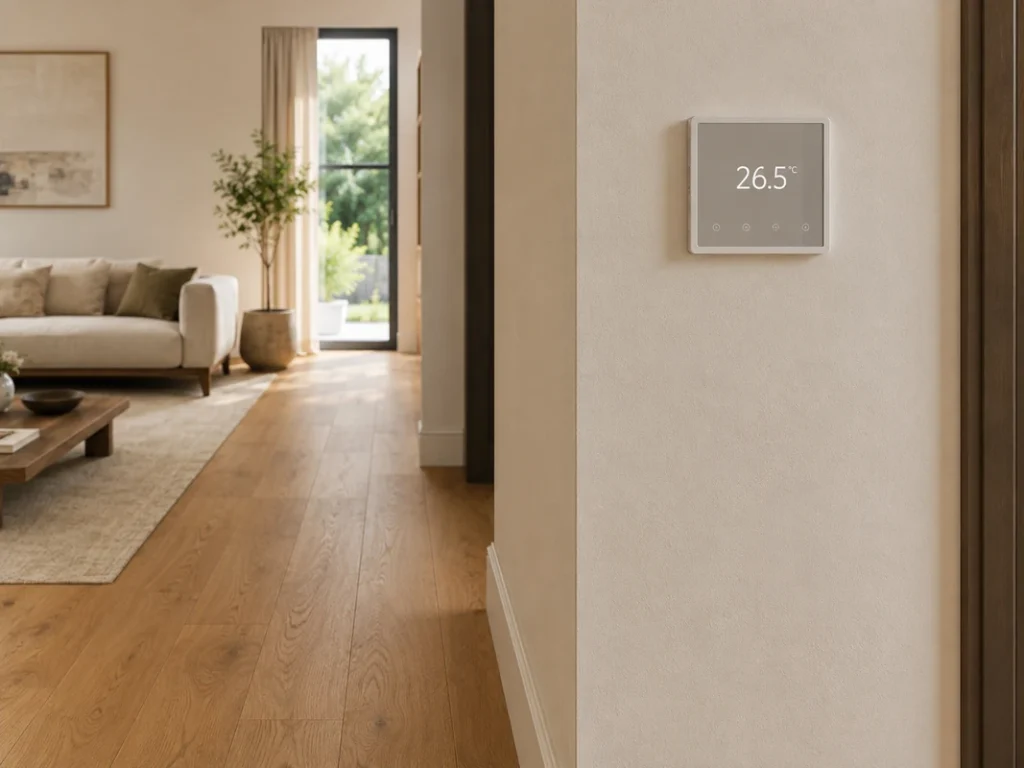
A room thermostat measures air temperature. Your floor does not care what the air says. The floor reacts to the temperature directly beneath and around the boards.
For example, a room may feel only mildly warm, but the floor surface under a thick rug or low sofa can become much hotter than the open area. That trapped heat can dry the wood too quickly and cause movement or damage.
This is why “the room is only 22°C” is not a proper safety argument. The wood surface might be much warmer in hidden areas. For engineered wood floors over radiant heating, the surface temperature is the number that protects the flooring
Why a Floor Sensor Is Essential
A floor sensor is not optional if you want a safe, controlled system. It measures the actual temperature at floor level and helps prevent overheating. Warmup states that installations should be completed with a floor-sensing controller, and floor sensors are used to validate proper system control and warranty conditions.
Without a floor sensor, you are trusting an air thermostat to protect a timber product sitting directly above a heat source. That is a weak setup. A proper thermostat with a floor probe gives the system a hard limit and helps protect the floor from avoidable damage
Best Engineered Wood Flooring for Underfloor Heating
The best engineered wood flooring for underfloor heating is not simply the most expensive board or the best-looking oak. It is the board that combines UFH approval, stable construction, suitable thickness, correct installation method, and good heat transfer.
In simple terms, choose a product designed for heated subfloors. Do not buy a random engineered wood product and hope it behaves well. Hope is not an installation strategy
Choose a UFH-Compatible Board
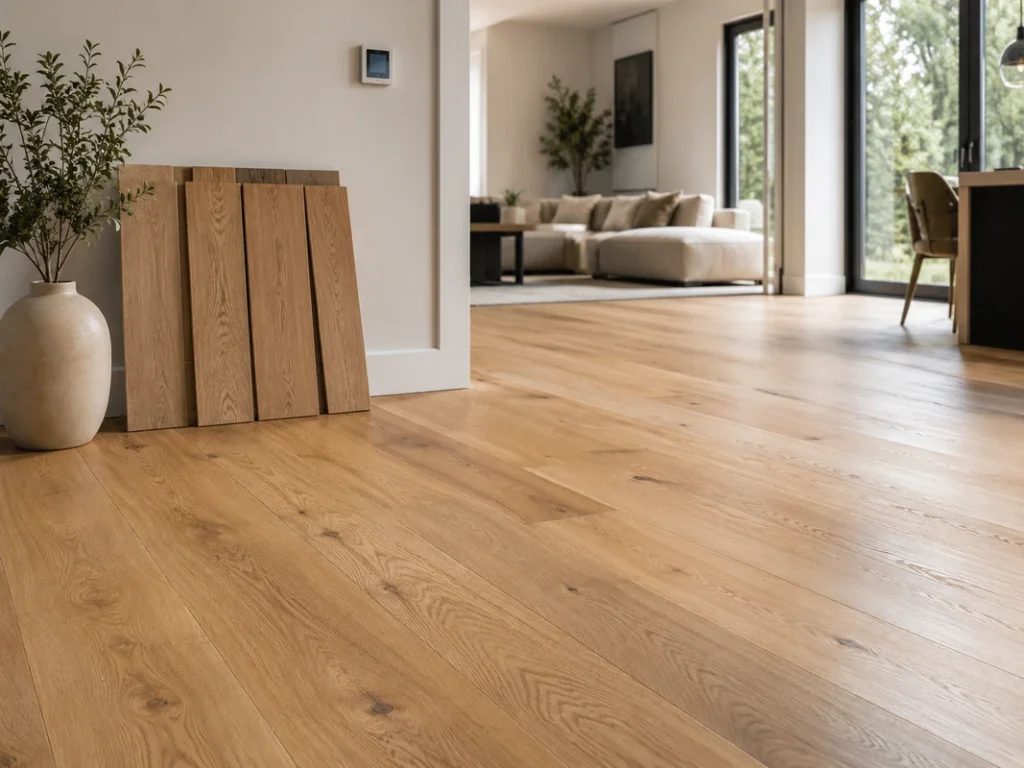
Start with manufacturer approval. The product should clearly state that it can be used with underfloor heating. This is especially important for warranties. If the floor fails and the product was never approved for UFH, the responsibility will likely fall back on the buyer or installer.
A UFH-compatible board should come with technical guidance, including maximum temperature, acclimatisation instructions, subfloor requirements, and recommended fitting method.
This is where many projects go wrong. People choose flooring based only on colour and price. That is amateur thinking. For heated floors, technical compatibility comes first. Design comes second
Best Thickness for Heat Transfer
Thinner engineered boards usually transfer heat more efficiently than very thick boards. Warmup notes that thinner and denser wood allows quicker heat-up and better system efficiency.
As a practical rule, many UFH projects use engineered wood around 14–15 mm thick, but the exact best thickness depends on the board construction, top layer, core, heating system, and manufacturer guidance. Very thick boards can reduce heat transfer and make the system work harder.
Do not think thicker always means better. For underfloor heating, excessive thickness can act like insulation. The result is slower heat response, reduced efficiency, and more pressure on the heating system
Board Construction Matters More Than Wood Species
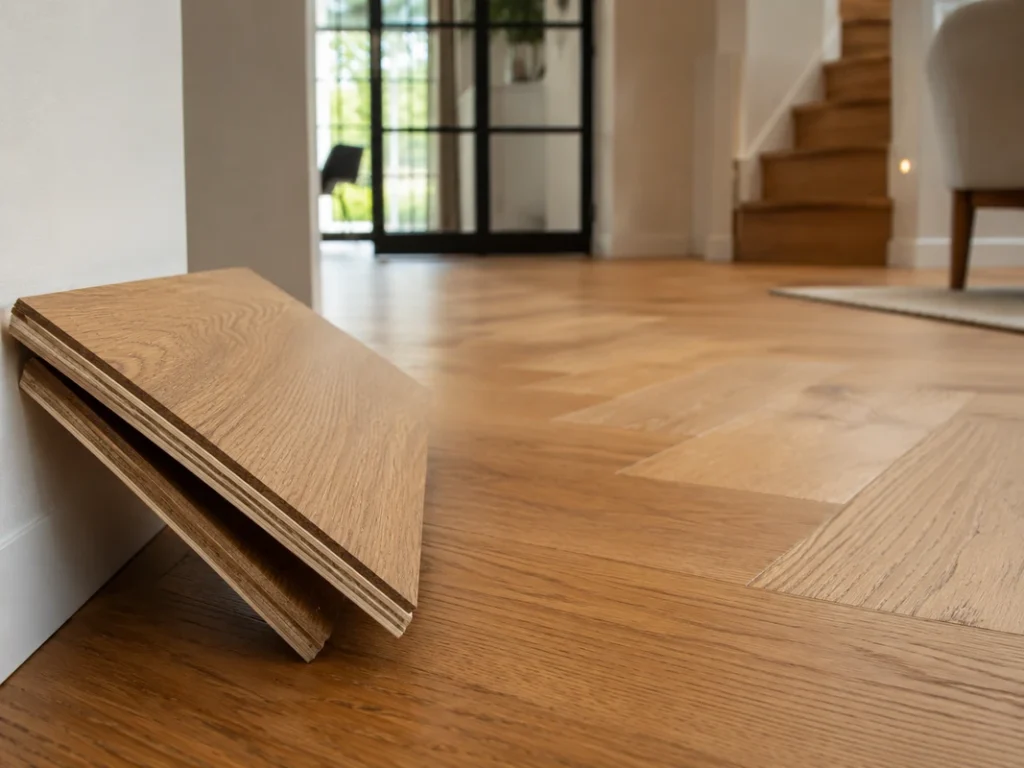
Oak is popular, but species alone does not decide UFH performance. Board construction is more important. A well-made engineered oak floor with a stable plywood core is usually a safer choice than a poorly made board with attractive surface grain but weak internal structure.
Look for high-quality bonding, a stable multi-layer core, reliable manufacturing, and clear technical documentation. A cheap board with no serious data is not a bargain. It is a risk wearing a nice wood pattern
Electric vs Water Underfloor Heating Under Engineered Wood
Both electric and water underfloor heating can work with engineered wood flooring when the system is correctly designed and controlled. Kährs notes that both electrical and water-based systems can be used with wood flooring, provided the system delivers even heat and stays within temperature limits.
The better choice depends on the room, project type, energy setup, floor build-up, and budget
| Feature | Electric Underfloor Heating | Water Underfloor Heating |
|---|---|---|
| Best for | Bathrooms, small rooms, renovations, single-room upgrades | Whole-house heating, new builds, larger areas |
| Installation depth | Usually thinner and easier to retrofit | Usually needs more floor build-up |
| Running cost | Can be higher for large areas | Often more efficient for large spaces |
| Heat control | Fast response, good with smart thermostats | Slower response but stable heat |
| Use with engineered wood | Safe if approved, sensor-controlled, and temperature-limited | Safe if properly commissioned and evenly distributed |
| Main risk | Overheating without a floor sensor | Poor commissioning or uneven heat distribution |
Electric radiant heat under engineered wood floor systems must be installed with extra attention to sensors, insulation boards, thermostat limits, and the flooring manufacturer’s instructions. Electric systems can heat quickly, so temperature control is critical.
Water systems are often better for larger homes because they provide steady heat over wide areas. However, they still need proper commissioning before the wood flooring is installed. Installing timber over a wet or untested screed is asking for failure
Before Installation Checklist
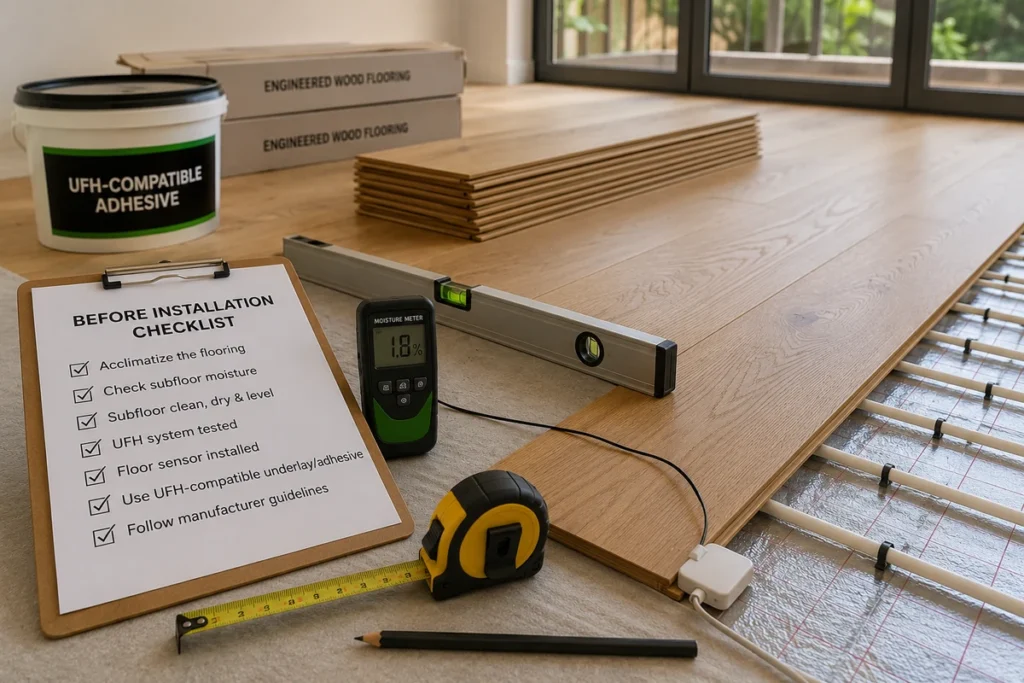
Before installation, confirm that the engineered wood flooring is approved for UFH. Then check the maximum permitted surface temperature, recommended installation method, and humidity requirements.
- The subfloor must be dry, clean, level, and stable. If it is a screed, it must be fully cured and moisture-tested. If it is timber, it must be structurally sound and suitable for the chosen system.
- The heating system should be commissioned before the flooring is fitted. This helps drive out moisture and confirms the system works correctly. After installation, heat should be increased gradually, not blasted on full power.
- Use the correct underlay or adhesive. Not every underlay is suitable for heated floors. A poor underlay can block heat transfer and reduce performance. A wrong adhesive can soften, fail, or move under heat.
- Also plan furniture and rugs carefully. Thick rugs, rubber-backed mats, and heavy low-clearance furniture can trap heat and create hot spots
Common Mistakes to Avoid
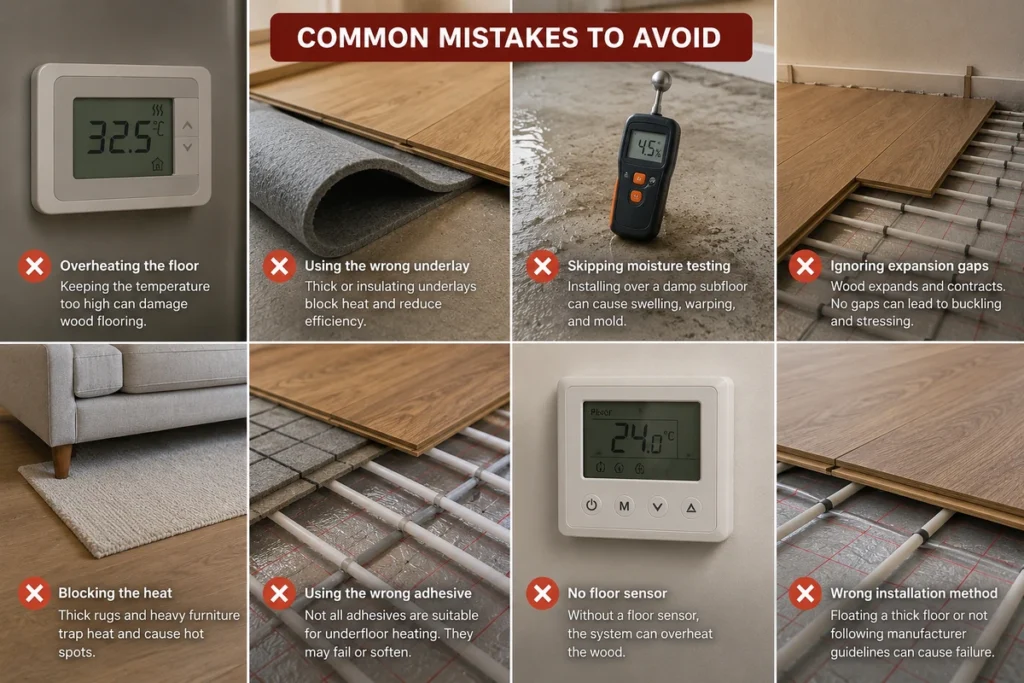
- The biggest mistake is choosing flooring based only on appearance. With UFH, a floor is not just decoration. It is part of a heating system.
- Another common mistake is ignoring the 27°C surface temperature rule. People focus on room comfort and forget the wood itself has limits. If the floor gets too hot, the damage may not appear on day one. It may show later as gaps, checking, distortion, or finish problems.
- Using the wrong underlay is another weak move. Thick insulating underlay can reduce heat transfer and force the system to work harder. Always choose a low thermal resistance underlay approved for underfloor heating.
- Skipping moisture testing is also dangerous. Wood and moisture problems are brutal because they often appear after the job looks finished. A beautiful floor installed over trapped moisture can become a disaster.
- Finally, do not cover large heated areas with thick rugs or fixed furniture. These block heat movement and can cause local overheating
conclusion
Engineered wood flooring and underfloor heating can work very well together, but only when the product and system are designed to cooperate. The safest setup uses UFH-compatible engineered wood, controlled surface temperatures, a proper floor sensor, suitable thickness, correct subfloor preparation, and gradual heating.
The best engineered wood flooring for underfloor heating is not the prettiest sample board in the shop. It is the board with the right technical approval and stable construction. If you respect the temperature limits and installation rules, you can get the warmth of UFH with the natural look of real wood flooring. If you ignore them, you are gambling with an expensive floor
FAQs
1- Can you put underfloor heating under engineered wood?
Yes, you can put underfloor heating under engineered wood if the flooring is approved for UFH and the system is controlled properly. The floor surface temperature should stay within the manufacturer’s limit, commonly no higher than 27°C
2- What is the best engineered wood flooring for underfloor heating?
The best option is a UFH-compatible engineered board with stable multi-layer construction, suitable thickness, good heat transfer, and clear manufacturer guidance. Board construction matters more than wood species
3- Is electric radiant heat safe under engineered wood floor?
Yes, electric radiant heat under engineered wood floor systems can be safe when the flooring is approved, the system uses a floor sensor, and the maximum surface temperature is limited. Without proper control, electric systems can overheat the floor
4- What temperature is safe for engineered wood over underfloor heating?
Many manufacturers use 27°C as the maximum safe floor surface temperature, but you should always follow the specific limit given by the flooring manufacturer. Surface temperature matters more than room air temperature
5- Is solid wood suitable for underfloor heating?
Solid wood is generally more risky than engineered wood because it expands and contracts more with heat and humidity changes. Some specialist solid wood products may be approved, but engineered wood is usually the safer and more stable option
6- Is floating or glue-down better over UFH?
Both can work if approved by the flooring manufacturer. Glue-down installation can improve heat transfer because there is direct contact with the subfloor, while floating floors depend heavily on using the correct UFH-compatible underlay. The best method depends on the product, subfloor, and heating system